
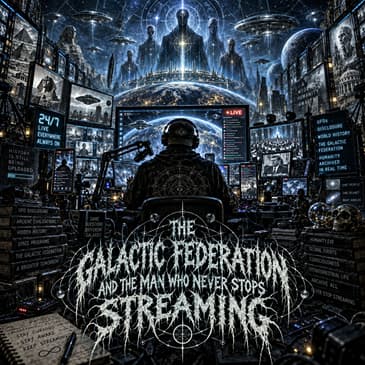
Rabbi Rothschild joins the show to discuss his unusual project of livestreaming his life 24 hours a day, seven days a week, creating what he describes as a digital diary and time capsule of modern human history.
The conversation eventually turns toward UFO disclosure and the extraordinary claims made by former Israeli space official Haim Eshed, including alleged government knowledge of extraterrestrial intelligence, a so-called Galactic Federation, secret cooperation with non-human civilizations, and the belief that humanity may not yet be ready for full disclosure.
We also discuss Eshed’s reported return to the subject after years of silence, alleged Men in Black encounters, whistleblower protections, Project Blue Beam, the growing acceptance of the UAP phenomenon, and whether disclosure will happen through one undeniable event or continue slowly over time.
Hosted by Simplecast, an AdsWizz company. See pcm.adswizz.com for information about our collection and use of personal data for advertising.
[00:00:03] And I just turned around and I pulled ass out of there. I was done. I wasn't dealing with that. The hypocrisy of the cult is one of the things that turned me away the quickest. When I turned my headlights on, it turned and looked at us. And one of the things I remember the most were the eyes were glowing red.
[00:00:30] I see an orb of light. It is just circling these steps like it is waiting for me. He begins to tell them that he saw a UFO. They're basically like, what are you talking about? That's seven foot up on a tree, peeking around it. And that's where I saw the top of the muzzle, nose and the eyes.
[00:00:58] As soon as I made eye contact with this thing, it felt like death. Welcome back to Tinfoil Tales. I'm your host, Brandon. Tonight we are joined by my guest, Rabbi Rothschild. Thank you for coming on here tonight and talking with me. Thank you for the opportunity. It's a pleasure to be with you and your audience. Would you like to let the audience know a little bit about yourself?
[00:01:23] Most certainly. I'm Rabbi Rothschild. I stream my life 24 hours a day, seven days a week, 365 days a year for world peace. I've been doing so for more than four years. My streams go back to the pandemic. We've seen the death of a queen, the birth of AI, the coronation of a king and everything in between. This is a real life Truman show, a real life big brother. This is a timeline and a time capsule of human achievement.
[00:01:52] In the 1990s, the phrase content is king was coined and I'm making it true today. I'm king of the internet. This is the biggest event in global history. And here's why. In 2017, the Economist magazine stated that data had overtaken petroleum as Earth's number one resource. And I have archived more data on the internet than any person ever, which is making me a very influential person.
[00:02:19] I'm going viral, God willing. And when I do, I'd like to make you, your friends, your family, all financially independent if you're not already. I want to ensure that you have generational wealth if you don't already. And I'd like you to be able to start charities and philanthropic organizations of your own. That is a mighty big quest. And I don't know how to ask the question to sound like not sincere, but like about everything that you could be doing.
[00:02:48] Like, how did this come about? Like, where did you get the idea to live stream 24 seven? Great question. Prior to the pandemic, I lived a traditional Orthodox Jewish lifestyle. Much more than I currently do while live streaming work. I'd be attending synagogue three times a day.
[00:03:07] I certainly was not someone who had really much of a social media presence, nor did I have much comfort being on camera for as much as I am today. However, as in addition to being an Orthodox Jewish rabbi, I'm a certified project management professional.
[00:03:29] And my position as a project manager for a major Fortune 100 organization went remote. So I went from going into work every day in a suit and tie to opening up my laptop and being on camera anywhere from eight to ten hours.
[00:03:51] And then from there, even some services and classes within my Orthodox Jewish community went online as well. So that increased the amount of time I was on camera for another two or three hours. So I was approximately during the pandemic spending about half of my day on camera when previously I never did before.
[00:04:14] And I recognized that if I'm already on camera for as long as I am and I am already sharing more than half of my life with strangers, essentially, I wouldn't necessarily think of it to be that strange to share the other part of my life.
[00:04:33] And it was during the pandemic after work each night after I would be able to leave my remote position and my classes had finished, I would go to Tiger Woods golf course in Anaheim, California, and hit golf balls. And I wanted to see what my drive looked like and what my swing looked like. And so I took out my phone and started recording myself.
[00:05:04] And I would make little jokes while on camera, knowing that I was on camera, whether I top the ball or slice the ball or hook the ball, whatever it was. And I thought, you know what? These are interesting videos that perhaps my future family, God willing, may one day want to see what their dear old dad was like. During the pandemic before he had met their mother and they were even a gleam in my eye.
[00:05:30] And so I began uploading that data after work in the evenings and recognize that each night it was becoming quite a responsibility to do all of this uploading. And I thought, you know what? There's got to be a better way. And really the better way is to stream it. And so I thought, all right, well, if I'm going to start streaming, I want to do it better than any person's ever done it before.
[00:05:56] And I had in the past seen the movie, The Truman Show, and certainly seen the television show Big Brother and thought, well, I'm not too different than most people during the pandemic. Many of us are having to become more comfortable being on camera. So why don't I buy some equipment that is dedicated to live streaming? So I bought some laptops and Chromebooks and tablets and iPhones and Android devices, you name it.
[00:06:26] Put them around myself in 360 degrees and created my first YouTube channel in fall of 2021. And as they say, the rest is history. I don't know if I could ever do anything like that. I'm not a big fan of being on camera, as you can tell. To me, I just don't use that portion of it. I don't like to be the focal point of things.
[00:06:52] So I don't know how I would ever get comfortable being on camera all the time. It's certainly a legitimate concern. And as I had previously stated, I was not someone who was really comfortable being on camera, at least not knowingly. I've worked in financial institutions in the past, and perhaps I was on security camera. But I don't really control those, and they're generally closed circuit.
[00:07:21] Certainly, the change occurred with me with my position going remote and also classes and some services also going remote, which caused me to have to get comfortable being on camera, whether I liked it or not.
[00:07:37] And I would say that my anxiety of being on camera that really many people experience when they don't have a lot of time live streaming or even just being on camera in general was reduced. And then you get into the more, I would say, private areas of your life that you're live streaming. So no longer is it when you're just in front of the screen.
[00:08:05] Now you're sharing your entire body. You're sharing yourself sleeping, eating, drinking, even bodily functions and showering from the waist up. I'll keep the camera to avoid any types of major privacy issues.
[00:08:26] Or I'll wear swimming trunks when I'm participating in some baths or showers or whatever it may be. But I do my best to give the viewer a portal into my life that I think will be studied in the future. Just as in the past, we had people who were journalists or people who would write in journals or diarists, people would write in diaries.
[00:08:50] And we've learned from historical standpoint much of how the world operated during that time of when they were documenting through their lens of generally a pen to paper. However, I felt that I could use a camera as a medium to be able to do the same. And really, once you start streaming many times, you recognize that you're on camera.
[00:09:18] But you also recognize that we're all not that different. That we all laugh and experience joy and humor. And we all are, you know, at times not as happy or perhaps can experience sadness. And I think that the people of the future will find this to be a fascinating project to be able to study not just what's going on in my life, but also what's going on in world history. Because 24 hours a day, I keep a radio on in the background.
[00:09:45] So you can literally go back to any moment of any day, essentially for the last half decade. And know not only what was going on in my life, but what was going on in world history. So everything that we just experienced with the World Cup or with the 250th anniversary of the United States or with wars or peace or whatever it may be. I've been able to archive that.
[00:10:10] And so people can literally use my stream now or in the future as an archive of human history. And in addition to just the historical aspect, I think people in the future will use it to understand more about humanity and about a human, about human biology. About things like eating habits, sleeping habits, circadian rhythms. Perhaps as a, I use my stream as a dream diary.
[00:10:38] Things like the idea of hygiene and different biological or biometric patterns that may be able to be studied by people. Really, I think aging as well. We don't have one person who basically has been on camera for this amount of time to be able to study the aging process over long periods of time.
[00:11:03] Yes, we have people who take maybe a single picture every day for an extended period of time, which is a great data point. But it's certainly not continuous as video is. So I think that those are just a few of the ways that people might be able to study my life in the future. And because I understand the potential value in this type of data, my anxiety of not necessarily wanting to be on camera all the time was lessened. And then eventually I have embraced it.
[00:11:33] I enjoy the fact that my life is archived and that I've created this digital diary for the people of the future. But in answer to your original question or statement, you don't just become comfortable immediately sharing your entire life with the world. It does take time. When you have to leave, how does that get live streamed?
[00:12:00] Like if you have to go to the store, if you have to go to an appointment, how does that happen? Certainly. I've definitely streamed at the store and definitely streamed at the doctor. I've streamed as far north as Santa Barbara, as far south as San Diego, as far east as the desert and mountains, as far west as the Pacific Ocean. I've streamed in Beverly Hills, in Los Angeles, at Disneyland, really everywhere in Southern California.
[00:12:27] And generally I have to reduce the amount of devices with which I'm streaming from my normal 33 or so different devices at any given time from a localized area, basically within my residence, to perhaps one or two iPhones that I generally use using data, which does have its limitations.
[00:12:54] Phones have battery issues with which you need to be concerned. And certainly data, you have to run into cellular throttling and overheating of devices and glare and all of the other app crashes, you name it. There are some issues with which you do, into which you do run.
[00:13:15] But I also do my best to back up any kind of live streaming that I have when I do do IRL streaming in real life with GoPros.
[00:13:24] So I'll wear a GoPro on my chest or even just have it with like a selfie stick so that I have myself with a redundant stream or redundant backup of any kind of data that I am transmitting in case I run into a low cell signal area or I do experience an app crash or whatever it may be.
[00:13:49] And while I do have a lot of footage from IRL streaming, it's certainly not as convenient for me because I have to lessen the amount of streams and I'm much more concerned with that, with how many devices I can use at once. And I also don't have the ability to manage my community. So in addition to live streaming, I also am live 24-7 in Discord.
[00:14:17] Your audience can find me whenever they'd like at discord.me forward slash rabbi where they can connect with me 24 hours a day, seven days a week, 365 days a year to inquire about questions that they may have or to watch a movie together or play a game, whatever it may be. And certainly when I'm doing IRL streaming, I can't manage that community as well or as easily.
[00:14:43] But generally the outside world has become fairly comfortable knowing that people are many times FaceTiming their family or friends or whatever it may be and that there is some idea of video communication that happens that perhaps a decade ago or two would have been foreign.
[00:15:07] And thus, if you see someone who's got a couple devices and maybe talking into one of the cameras or talking to an audience, it's not as strange as it once was. And in terms of, you know, how do you how do you go to the store? Well, many times just out of ease, I do have things delivered to me. But in the case where I do go to the store, I will go to the store just really like most anyone else.
[00:15:34] But while knowing I'm on camera and I would say I make comments on camera and to not just the audience that's watching me, but also to make the stream a little more entertaining. Generally, when I'm at the store and I'm not recording, you know, prior to this project, I would be silent like anyone else. And I would just, you know, view the different products and put them in my cart or whatever it may be.
[00:16:00] But in order to give the audience a little bit of a view into my mind, I may be a little bit more vocal. So that does change some things. But generally, because society has become more comfortable with people using devices in public, I don't run into many issues. So I really live my life generally while on camera in public as I do while the cameras are off.
[00:16:28] Is there anyone that's like reached out to you since you've been doing this and like have people like become more curious as to why you're doing it? Like in trying to like be involved with what you're doing? Yeah, I have. So I do have people who live alongside me in my discord, such as at this very moment. And they've been there for over a year, 24 hours a day. They have connected with me. They think it's fascinating.
[00:16:53] And just due to where they are in life, they're able to literally live every moment of every day alongside me. But then I have had people from an IRL standpoint or in real life come and visit me because they've been so fascinated by it. People as far away as eight hours. I've had people from Northern California visit me in Southern California.
[00:17:15] I've given them tours of my residents and to show them my different devices. And these are total strangers who I have invited. And we've gone on picnics and gone to the park and really just in many ways connected as friends when normally I wouldn't do that. I wouldn't be that open with my life.
[00:17:42] So from both an in real life way, I've connected with individuals and the digital way as well. And I do find that people are fascinated by this. They many times say to me, you know, I wish I would have thought that. I wish I would have thought of that. Or I've always wanted to do something like that, but I just couldn't because I was married or I had children or I had a job or whatever it may be.
[00:18:08] And generally, 99% of the people I encounter online, especially and IRL are very positive towards the project and recognize that it has the opportunity to change the world. If we can see that one individual, an influencer, so to speak, isn't that different than the rest of us? This has a very uniting effect potentially that may be able to impact people from a diplomatic standpoint.
[00:18:37] I have a world peace theme to my streams. I want world peace. And also I have a futurism theme to my stream. So I like to talk about things that people find fascinating. And hopefully it becomes more of a trend. I have found other people who are doing similar streams as well. They haven't been doing it as long as I have.
[00:19:01] I've surpassed over 1700 days, 24 seven of archive footage from multiple streams. But I have found people who have been live streaming their life for about a year or so. And then there are certainly people who are streaming their life, but they don't archive it. And to me, what's important is archiving it. If it's not archived, did it really happen? Is kind of a question that I pose.
[00:19:30] I think it's important that you can go back to any moment of any day of my life, the last half decade or so, and know exactly what I was doing. Not necessarily just saying, oh, I streamed it, but you can't watch it anymore. I want people to go back and be able to view it. So there are people who find the importance of archiving in addition to streaming, but no one has done it nearly for as long as I have, nor have they done it from as many different angles as I have, which I think make it really interesting.
[00:19:59] But in answer to your question, yes, I have had people reach out to me, certainly from a digital world and in real life. I was just kind of wondering how many other people since you've been doing this has like started to try and do this. So you've just kind of answered the next question I was going to ask, but I know like for what you are doing, I you're the first person that I have ever spoken to that's live streams all the time. So that's a first for my show.
[00:20:29] Excellent. It is. It has different names. Many people call it life logging, where you basically log every aspect of your life. Other people call it life streaming, where you literally stream your life. So it doesn't have one necessary name. It is unique. I certainly understand that. But to me, it's become part of my everyday experience. And really, I would like to do it for the rest of my life.
[00:20:58] God willing, I would like to give the world a nice digital archive that people can study, not just in the present day, but into the future, into centuries into the future. Just like we look at people's diaries or people's journals or ancient manuscripts about what life was like, and those are studied by historians. I think people might do the same with the Internet.
[00:21:23] We may have maybe some type of Internet archaeologists at some point in the future, and they hopefully don't need to discover my streams. Hopefully, I've gone viral by then, but if they needed to, they'd be able to understand what life was like in the present day, what life was like during the pandemic, and then how life has changed. And really, another interesting aspect of this is the AI revolution that we're experiencing.
[00:21:52] So I was live streaming beginning in 2021, fall of 2021, and I was an early adopter of OpenAI's ChatGPT in November of 2022. So I have over a year of my life that I was streaming before large language models became commonplace within our world.
[00:22:13] And I was a user when ChatGPT formally launched November 30th, 2022, and I've been able to see the many different ways that AI, for both good and bad, has been able to affect society.
[00:22:28] And then the competitors of ChatGPT and Gemini and Grok and MetaAI and OpenSea and all of the other, I would say, perhaps historical events that have occurred just based on AI.
[00:22:48] So I think that it'll be interesting for people in the future to look at my stream and understand how AI has affected the human experience as well. And of course, within AI, AI needs human models or at least examples on which to build its AI models.
[00:23:08] And I have more human data on which AI could model than any other individual ever, which may give me a prominent role in perhaps how AI understands some aspects of the human existence. So I think that my project has an interesting AI impact in addition to the historical importance that I mentioned previously.
[00:23:33] Mm-hmm. Well, one of the things that you'd mentioned you'd like to discuss earlier before we started to record was some of the UFO topics and some of the Galactic Federation things from the Israeli former defense minister. So if you would like to talk more about that, I'll turn it over to you. Absolutely. First and foremost, for anyone who is listening, I am a major advocate of disclosure.
[00:24:01] And UFOlogy, I believe this is a science that should be studied in a more serious manner. And I'm very positive to the fact that humanity is seemingly becoming more comfortable with understanding that we may not be alone in the universe.
[00:24:24] And so for anyone who may be unfamiliar, I'll give some background on who Chaim Ashed is and what his claims were and then some more recent developments that occurred. So Professor Chaim Ashed is an Israeli aerospace engineer, professor, retired military officer, and former senior figure in Israel's space program.
[00:24:49] He became internationally known in December 2020 after making extraordinary statements regarding unidentified aerial phenomena, UAP, extraterrestrial intelligence, extraterrestrial intelligence, a supposed galactic federation, and alleged government knowledge of non-human intelligence.
[00:25:10] Before those statements attracted global attention, Ashed had already spent decades working with Israel's aerospace and defense communities. He was recognized as one of the central architects of Israel's satellite capabilities and has been described in Israeli media as a major figure in the development of the country's space program.
[00:25:32] I've heard him described as the father of the Israeli space program or the grandfather of the Israeli space program or certainly the father of the Israeli satellite program or grandfather of the Israeli satellite program to give listeners an idea or a view into the Israeli space program and more so his role as a military officer.
[00:25:59] At any given time, there are only 24 generals within the Israeli military and he was one of them. So you can imagine that this is a very high-ranking official who was making these claims. And to give you an idea of some of his career and technological development, he served in the Israeli defense forces, including within military intelligence structures.
[00:26:24] He became associated with highly advanced technological development programs, including work connected with intelligence technology. He was part of a very secretive group called Unit 81 that has to do with advanced technology. He served in Israel's highly classified Unit 81, which is an organization responsible for developing technological solutions for military intelligence.
[00:26:51] The units associated with advanced electronics, the units associated with advanced electronics, surveillance technology, specialized intelligence systems, and innovative military engineering. Working in such environments placed a shed among engineers dealing with some of the most advanced technology available. He became a leading figure in Israeli space development. He served as the director of space programs for Israel's Ministry of Defense.
[00:27:21] He was a chairman of space-related committees and a member of the steering committee of the Israeli Space Agency. And really has been reported as having led space activities for nearly three decades. Moreover, he had a major role in Israeli satellite programs, specifically the OFEC satellite program.
[00:27:46] This program developed Israeli intelligence satellites capable of Earth observation, strategic monitoring, and intelligence gathering. And in 2007, he was involved in the launch of OFEC 7, which was an Israeli reconnaissance satellite. He has been extremely decorated. He has received the Israeli Defense Prize three times.
[00:28:13] The Israeli Defense Prize is among Israel's highest honors for contributions to national defense technology. The reasons for some awards remain classified because they relate to sensitive defense projects. So actually, two of his Israel Defense Prizes, we don't necessarily know why he was given those because they remain classified. He received the Chief of Staff citation in 1967, one of the IDF's highest military recognitions.
[00:28:42] And really what we're talking about here is perhaps one of the most decorated officers within the Israeli military who made these claims in 2020. And to give the audience an understanding, this would be in a similar way to perhaps a member of the Joint Chiefs of Staff making a claim about extraterrestrial intelligence within the United States, except this happened in Israel.
[00:29:08] And in 2011, Chaimashad retired from government space leadership. And really, he then became a professor, a lecturer, a consultant, and a participant in discussions regarding future technologies.
[00:29:26] His interests expanded beyond traditional aerospace engineering into questions about artificial intelligence, space exploration, the future of humanity, and the possibility of extraterrestrial intelligence. So that gives us a background on Chaimashad. And then moving into 2020, he was born in 1933.
[00:29:50] And so in 2020, he was approximately 87 years old when he made the claims that he did. His major UFO statements became public in December 2020. The importance of his age and at that stage of his career. He was speaking after a long professional career. He had already achieved recognition in aerospace.
[00:30:15] And he stated that his reputation was established and that he had little personal incentive to seek publicity. His supporters viewed his age and career history as reasons to take his statement seriously. His critics argued that extraordinary claims require extraordinary evidence regardless of his background.
[00:30:34] Now in 2020, he specifically November 2020, he had written a book and then he had an interview in December of 2020 that changed his public image. In December 2020, he gave an interview to the Israeli newspaper Yedioth Aharonoth in which he discussed claims regarding extraterrestrial civilizations and secret interactions.
[00:31:02] He described UFOs as being unexplained technology. He argued that certain unidentified objects demonstrate capabilities beyond known human technology. He stated the UFOs perform maneuvers that cannot be explained by existing human technology. His argument focused on advanced propulsion, unknown physics and technology beyond current aerospace understanding.
[00:31:29] One of the more controversial statements that he made was that humanity had contact with an advanced group he called the Galactic Federation. He claimed certain governments were aware of this relationship, the relationship involved cooperation and that the beings were studying the fabric of the universe. He also stated that the aliens have asked not to announce that they are here. Humanity is not ready yet.
[00:31:57] Humanity response, McMahon. Humanity science, humanit Simuliff One of the more official arguments than anything proved to be said on campus that he showed an unlike the whole.
[00:32:26] He argued that if confirmed, these discoveries would create new scientific fields, including archaeology of Mars. There's also been the discussion of xenobiology, basically a study of biology from perhaps species outside of Earth. The reaction to his claims was immense.
[00:32:48] There was a great amount of global attention from these statements, and many people focused on the contrast that was had between his decades of conventional aerospace work and his extraordinary extraterrestrial claims. Certainly with any claims like this, one might be met with scientific skepticism, and the same is true in this case. Scientists and space officials responded cautiously.
[00:33:16] NASA has stated that humanity has not yet confirmed evidence of extraterrestrial life, and many of Chaim Eshed's critics argued that there was no publicly available evidence supporting his claims. His reputation alone cannot substitute for verification, and of course, extraordinary claims require publicly testable evidence.
[00:33:39] Now, specifically, there was more criticism as well because Chaim Eshed was promoting a book known as The Universe Beyond the Horizon, Conversations with Professor Chaim Eshed. The book was published in November 2020 by Yedioth Books in Israel, and it was also distributed through Geffen Publishing House. It is only available even to this day in Hebrew.
[00:34:09] So the information that I am communicating has been translated. Additionally, the interview that he did with Israeli media was also in Hebrew. And if I may say to the publishers of this book, if they wanted to sell more copies, and even to this day, if they wanted to sell more copies, this should be made available in English.
[00:34:39] But even up to this day, it is not. The book is about 232 pages, the majority of which was reviewing his life and his background. It was written alongside an author, Hagar Yanai. The book is not written as a traditional autobiography solely by Eshed.
[00:35:03] Instead, it was structured as a series of conversations between Chaim Eshed and Israeli author Hagar Yanai. It goes into his childhood and personal history, his engineering education, his military and aerospace career, the development of Israel's space program, his views on humanity's future, and then his thoughts regarding extraterrestrial intelligence and disclosure in the epilogue.
[00:35:29] Now, with going into the epilogue and what specifically he stated, it begins with the idea, are we alone? And Eshed discusses the UFO, UAP phenomena, possible extraterrestrial visitation, alleged government knowledge, possible advanced civilizations, and the future implications of contact.
[00:35:56] The argument presented by Eshed in terms of UFOs and unexplained phenomena is that some reported unidentified objects demonstrate characteristics that challenge current human technology. Eshed in terms of UFOs and UFOs and its own technology are the same. These include objects displaying unusual flight capabilities, phenomena that appear inconsistent with known engineering, the possibility that humanity does not yet understand all forms of technology.
[00:36:25] Eshed in terms of UFOs and UFOs and its own technology, and he frames the UFO question as a scientific issue rather than merely a cultural phenomenon. The Galactic Federation concept, which is probably his most controversial claim, he states that there are advanced civilizations that exist, that humanity has allegedly interacted with these civilizations, and certain governments are aware of the interaction.
[00:36:50] Eshed in terms of UFOs and its own, he then goes into the psychological argument that humanity is not ready for disclosure. Some of the reasons are fear of societal disruption, psychological shock, religious implications, political consequences, and related topics.
[00:37:10] His most famous subject specifically on this is that the aliens have asked not to announce that they are here, humanity is not ready yet, which represents the idea that disclosure is delayed because humanity must mature first. He talks about Mars as a possible archaeological location.
[00:37:31] He discusses images of Mars missions, possible artificial structures, and the possibility of ancient civilizations, and really feels that the archaeology of Mars is a new scientific discipline, that traditional Mars explanation is focused on geology, climate, and searching for microbial life. But he suggests that there should be an expansion of this vision toward ancient structures, artifacts, lost civilization, and planetary history.
[00:38:01] He talks about the relationship between science and speculation. The book has an unusual combination. One of the unique aspects of the book is that it combines established science, things like aerospace engineering satellites, space exploration, and technology development with speculative science, extraterrestrial civilizations, UFO phenomena, and galactic cooperation. The public reaction to the book was quite unique.
[00:38:30] After excerpts and interviews were translated into English, the book gained worldwide attention. Media coverage focused primarily on the Galactic Federation claim, alleged government cooperation, his Mars statements, and disclosure themes. Now, the major themes that he discusses are that space is humanity's destiny. Humanity must expand beyond Earth. Exploration is part of civilization's evolution.
[00:39:00] He also says that technology and scientific progress changes what humanity considers possible. He states that the cosmos may contain intelligence beyond Earth, that knowledge requires responsibility from a disclosure standpoint, and humanity must develop psychologically and ethically. And the discovery of another intelligence would redefine human history.
[00:39:28] Now, the specifics that people may find of interest within the book, specifically within the epilogue, are perhaps, I would say, unique opinions of a shed. One is the idea of cosmic encounters.
[00:39:54] One is the idea of cosmic encounters.
[00:40:24] The second kind. These do not have direct physical interaction, and these represent the basic level of unexplained observation. The second kind are those types of encounters that have physical effects, reports involving measurable effects such as electromagnetic disturbances, physical traces, and effects on vehicles or environmental changes.
[00:40:47] The third kind, certainly the most famous of them to date, reports involving witnesses observing beings associated with unidentified craft. And he moves a discussion from technology to biology and intelligence. And then the fourth kind, human interaction, reports involving communication, medical examinations, direct encounters, and alleged abduction experiences.
[00:41:13] The transition from observation to physical evidence occurs in his category five, biological evidence and non-human remains. He introduces a category involving alleged examination of non-human biological remains. The scientific consequences would transform biology, evolutionary theory, anthropology, medicine, and the understanding of life itself.
[00:41:41] Category six involves objects within Earth's orbit, extending the phenomenon into space. It should include observations of unidentified objects beyond Earth's atmosphere. Objects operating in Earth orbit would represent a technological mystery, a security issue, and evidence of possible non-human activity. Objects operating in Earth's orbit, he moves into category seven with astronaut observations.
[00:42:07] He references accounts involving astronauts perhaps observing unexplained objects in space. The importance of astronaut testimony. He states that astronauts represent highly trained observers, and these observations carry significance because they occur during carefully documented missions. And then moving into the final category, he references artificial structures beyond Earth, moving from UFO research to cosmic archaeology.
[00:42:36] The category represents the largest conceptual expansion. The question changes from are objects visiting Earth to have intelligent civilizations previously existed elsewhere in our solar system. He then discusses within the epilogue of his book some historical events and alleged ancient technology. He references a 1994 event, the Comanche Point or Grand Canyon case.
[00:43:06] He describes an ancient craft discovered in the Grand Canyon region of the United States. He presents it as evidence of long-term presence of advanced technology. Allegedly, the craft is described as approximately 4,000 years old, and the arrival is associated with approximately 200 before the Common Era. A quote that's attributed to him is that the internal structure showed that the alien crew were human-like, short, and oxygen-breathing.
[00:43:36] He states that there are archaeological implications that this case presented is potentially connected with ancient artwork, regional traditions, and historical mysteries.
[00:43:47] He then references a key artifact discovered after World War II that an arrow-shaped craft component was found underground, and the internal technology allegedly contained control systems, advanced equipment, unknown technological components, and there may be some type of Sanskrit connection. He states that the markings resembled ancient Sanskrit, but not that it was ancient Sanskrit.
[00:44:16] And the historical implications of this have verified the case would suggest advanced technology existed before modern civilization. Human history may contain unknown technological chapters. Human history may contain a few years, and he references these before going into a 1968 case, the Timmonsdorf, Germany incident, where he describes a disc-shaped craft containing 12 small bodies. He suggests that these beings were not natural biological organisms in the traditional sense.
[00:44:46] A quote that's attributed to this 1968 case of Haim Ashed was that the bodies seem to have come out of an assembly line as a product of cloning. The idea of artificial life and its implications raises questions about cloning engineered organisms, manufactured biological entities, and advanced biotechnology.
[00:45:09] He then goes into some of the understanding of what's going on in Mars, that there perhaps is some type of fortress there, at least from the photographs or evidence that he has seen. And he proposes a new scientific field, the archaeology of Mars, and that exploration when it does occur should involve excavation, preservation, and analysis of possible ancient structures.
[00:45:38] He states that new areas of research will open up, for example, archaeology of Mars, and perhaps future astronauts going out to Mars will have to be trained in archaeology. Now, the ideas that he references in terms of the Galactic Federation specifically is the idea of cooperation between humanity and advanced non-human civilizations.
[00:46:04] He claims that certain governments have knowledge of these interactions. According to Ashed, secrecy exists because humanity lacks the readiness and is just generally not ready. And that we have to move beyond Earth-centered thinking and think of humanity's cosmic responsibility. And that this is a beginning of a new scientific era.
[00:46:30] Potential future disciplines include xenobiology, cosmic archaeology, advanced physics, and interstellar diplomacy. And these aspects of the book certainly made waves. But where there were even more waves that were made were in his newspaper interview.
[00:46:52] And so, as I previously stated, this interview took place in Yediot Aharonot, which means latest news or recent news in Hebrew. The Yediot means news or pieces of information. And the Aharonot means last, latest, or most recent. This is a major publication within Israel.
[00:47:16] And it was unique to publish this type of information that created this international UFO controversy. On December 2nd, 2020, Professor Chaim Eshed was interviewed, or at least the interview was published.
[00:47:39] And the idea is that not only do his main arguments from his book, not only are they referenced within this interview, but additionally, he goes into some more specifics, including the fact that Donald Trump allegedly is aware of the disclosure movement
[00:48:06] and the idea that Donald Trump was aware of the alleged extraterrestrial situation, that Donald Trump considered revealing the information, and that the alleged extraterrestrial group, meaning the Galactic Federation, supposedly discouraged disclosure because humanity was not ready.
[00:48:25] A publication of this interview was also published in the Jerusalem Post, but it was, this was an English language and did not go into the specifics. The original Hebrew discussion contained more detailed explanations, more background regarding Eshed's reasoning, additional comments about the UFO phenomenon.
[00:48:49] Now, what becomes really interesting is the fact that after December 2020, we don't hear very much from Chaim Eshed at all. So he publishes the book in November 2020. It is never published in English. He does an interview in December 2020 in Hebrew and then disappears. And there were many different questions. What happened to Chaim Eshed?
[00:49:18] What happened to Chaim Eshed? What happened to Chaim Eshed? Well, it turns out that perhaps conveniently, we have the introduction last month of an interview that Chaim Eshed did with Brie Geller, the famous super paranormal researcher.
[00:49:43] And what occurred was that on June 10th, 2020, Uri Geller interviewed Chaim Eshed. They're both Israeli. And this interview occurred in English, which was unique. Previously, Chaim Eshed had generally had his communications solely in Hebrew. And they addressed the public inquiry.
[00:50:10] Geller opens by acknowledging that there were thousands of inquiries regarding Eshed's multi-year silence following his controversial 2020 revelations. And Chaim Eshed references a men in black encounter. He attributes his withdrawal to a visit from mysterious, untraceable figures at his apartment.
[00:50:32] These individuals demonstrated intimate personal knowledge of his life and questioned him on sensitive topics, including nuclear physics. Chaim Eshed chose to cease public discourse on the subject following this encounter until he could consult with Geller. The idea that Chaim Eshed shared in 2020 was not recanted.
[00:50:58] If anything, the information that was shared in 2020 is reinforced. Chaim Eshed details in this interview his background in special units focusing on developing advanced non-conventional solutions to penetration and transmission. There's a technological focus. Chaim Eshed describes his work involved quantum technologies and advanced scientific concepts that remain beyond common description.
[00:51:25] Chaim Eshed describes his knowledge when humanity is prepared and claims that his findings are supported by semi-scientific references from various nations. Chaim Eshed describes his and reaffirms the existence of the Galactic Federation. Chaim Eshed states that the Galactic Federation,
[00:51:50] Chaim Eshed and Geller have a discussion on the potential impact of physical alien contact as an atomic tsunami. And the two express a shared hope that extraterrestrial knowledge will eventually help humanity end wars and eliminate nuclear threats. Chaim Eshed is a shared hope that the Galactic Federation, Chaim Eshed was perhaps threatened,
[00:52:19] is similar in UFO lore, this men in black archetype. Eshed's account of being visited by untraceable figures parallels historical reports of men in black categorized by their sudden appearance, detailed knowledge of witnesses and disappearance. His, despite his lack of physical evidence,
[00:52:40] Chaim Eshed's distinguished intelligence career lends gravity to the discussion within the context of ongoing global UAP unidentified anomalous phenomena interest. Geller and Eshed indicate a forthcoming collaborative project aimed at presenting this information to the public more effectively. And there are historical parallels on June 9th, 2026. Geller framed this collaboration against his own 1970s experiences with the Council of Nine,
[00:53:08] linking the current disclosure to the longstanding history with channeled communications and figures like Gene Roddenberry. Geller, And so, really, that is an overview of what Chaim Eshed stated in his book in November of 2022, and in an interview that he did within Israeli media organization in December 2022,
[00:53:37] and his most recent interview with Uri Geller in June of 2026. Geller, And while we don't necessarily know exactly what is going on because Chaim Eshed wasn't able to provide any evidence aside from his words, that isn't to necessarily discount what he has said.
[00:54:02] These were some major statements that made an impact in ufology in general. And perhaps the end of the story has not yet occurred, as we did have some recent developments just last month.
[00:54:19] And perhaps Chaim Eshed isn't done with revealing any more information that he may have or that similar officers and whistleblowers have. But generally, Brandon, that's an overview of Chaim Eshed and what his statements in 2020 were and in 2026. Do you have any questions?
[00:54:45] There's a lot of stuff that I could ask questions about, but do you believe that from everything that you've researched from what he talked about, do you think that he had the knowledge to know about these other entities, these other extraterrestrials and everything? Like, just because if he had all the intelligence and everything, how come now he's coming out with it, but people are discrediting him? Certainly. Certainly.
[00:55:14] He feels at his older age, when he first made these statements, he was 87 years old and then now being 93, that he had nothing to lose. And he goes into some more detail about consciousness, death, and the possibility that consciousness continues after the body ends. And perhaps he's becoming more comfortable with his own mortality.
[00:55:42] In terms of how does he know this information, he doesn't really go into too much detail of that. It's not as if he says, I sat at this table and they briefed me or that I had direct communication with aliens telepathically. We don't have a good understanding of how he acquired this information aside from the fact that it was acquired during his experience with the Israeli Space Agency.
[00:56:12] And the fact and lack of evidence is disheartening. But we do find that that is somewhat common within ufology and with any whistleblower, that if he did have some type of direct evidence, that he could potentially have some type of compromise or he may be compromised in one way or another.
[00:56:38] This could be against perhaps non-disclosure agreements that he may have made or perhaps other types of agreements that were required due to classification or some type of military intelligence compartmentalization.
[00:56:57] So it is disheartening that he doesn't have any proof, so to speak, of what he says, aside from his extremely gilded and extremely, I would say, unique role within the Israeli military and Israeli space agency. Do I believe what he has to say?
[00:57:49] Necessarily being a, what we would consider what is referenced as a type one civilization that has been, we have as humanity been referenced as perhaps a type, perhaps something along the lines of a 0.7.
[00:58:10] Anyway, for people who aren't aware, a type one on the Kardashev scale can harness all energy available on its home planet. It includes solar geothermal, oceanic and nuclear capabilities. Type two harnesses the total output of its star. and Type 3 harnesses energy across the entire galaxy.
[00:58:37] And Nikolai Kardashev, again, a Soviet physicist, poses these different types and where humanity may fit. And we're not yet at a Type 1 civilization. So that type of understanding that we have to mature to get to this Type 1 civilization and eventually get a seat at the Galactic Federation
[00:59:04] is in line with some other physicists and whistleblowers. Additionally, the idea that Earth civilizations or really nations on Earth, having had this knowledge and they have to keep it classified and it's much of what the classification and the intelligence realm, one of its major responsibilities is to not necessarily leak this information.
[00:59:31] That is consistent as well with the intelligence community and whistleblower claims. What I don't necessarily get all on board with in terms of Chaimashad are some of the specifics that he talks about with Mars. He does go into the idea that there is some type of base, perhaps, on Mars that is a joint collaboration between the United States
[01:00:00] and the Galactic Federation. There are some major technological issues with getting humans off Earth safely. And especially to be able to travel all the way to Mars does lend some questions to it. I would also say that I do think that the idea of Chaimashad, knowing something and being of sound mind,
[01:00:33] is apparent. Even at 93 years old, if you watch his interviews, his interview, he doesn't seem to be forced to be making these statements. He seems comfortable. And another interesting aspect is it does not seem like he's doing this for money. If he were, he would be on the book tour circuit. Of course, his book, he would really be an advocate
[01:01:01] that it would be published in more languages. He might put out documentaries. This was not done, which was quite unique as well. And I think that his interview really remains one of the most important UFO disclosure discussions in the modern era because of his role and some of the claims that he makes. Do I think that we can believe absolutely everything that he states?
[01:01:30] No, perhaps we can't do that with anyone. But at least for someone as high ranking as he was and is and how respected he is, at least within the Israeli space community, his statement should be taken with some interest. And his background does lead to some credibility.
[01:01:57] But in terms of can you take it all as truth? Not necessarily. And as previously has been stated, these great claims that he makes need to be backed up with evidence. And at this point, that evidence doesn't necessarily exist. So for the time being, it's an interesting disclosure
[01:02:26] that he makes that perhaps will be able to be verified in the future. But at this time, it cannot. I just think that there's a lot of stuff out there, especially with disclosure stuff going on. I just seen recently that now they're talking about waiving the NDAs for whistleblowers. That was a thing that would come out this morning, I think, for here. So it's like there's something going on
[01:02:56] with the government wanting to release this information. And I can't say that it's a bad thing, but at the same time, I don't know if I 100% believe everything that's being pushed to. I'm in agreement with you. I am an advocate for whistleblower amnesty, which is generally what this is known as, and the fact that there has been generations of people who have been compromised
[01:03:23] within the intelligence compartmentalization. And they've been threatened. They've had their families threatened. And when people undergo such desperate events, they are willing to keep their mouths shut. And I think that it's time that we handle this discussion of disclosure and our overall not being alone
[01:03:52] in the universe with maturity. And so I'm positive for the developments that have happened recently, including today, and the pushes of different hearings that have occurred on the UFO subject or UAP subject. And the topic at hand, if you ask the average individual, according to Pew Research and CBS News and other polling organizations,
[01:04:20] a majority of people do not believe that we are alone in the universe. And this is really unique, meaning those of us who are advocates of disclosure are the majority. And it's just taking time over the course of the last century or so, really more specifically, probably, just the 79th anniversary of Roswell happened this month.
[01:04:49] And so it's taken maybe arguably a little more or less, give or take 80 years for humanity in the modern age to begin taking this subject with the severity that it may require. And I'm positive toward more and more disclosures, whistleblower amnesty. We had in 2017, the topic of ufology being taken very seriously
[01:05:18] on the front page of the New York Times. And so no longer was this some type of fringe theory. This is being taken as seriously as any news story that has ever occurred. And the important thing is, this is the most important news story, perhaps to ever occur. And that is why it has taken so long to be legitimized, because if it is true, it affects every single person on earth. It affects our history.
[01:05:47] And perhaps more importantly, it affects our future. Yeah, I agree with that. And I think that, I hope, I say, that more will come to light here eventually. But I think a lot of people have just been to the point to where it's hard to believe everything that gets posted out there, everything that's being mentioned out there and everything. Like, we live in an age of, we've all been programmed for, like, disinformation. And a lot of other things, for so many years,
[01:06:17] when it comes to UFOs and extraterrestrials or any non-inhuman intelligences, it's all been so secretive. And everyone that's ever brought it up before, oh, that's not true. Now all of a sudden, it's more acceptable. People have been desensitized from it. So I'm hoping that this will come to the point to where there's more information eventually released. It's not anything that's, I guess the stuff that's already out there has been kind of disappointing for me, because a lot of the stuff,
[01:06:46] if you've been interested in the UFO phenomenon for all these years, we've kind of already known about a lot of the stuff that they've been releasing. That's true. There's no doubt about that. And while you and I may have our finger on the pulse of UFOlogy, the UAP movement, for the people who do not necessarily have the knowledge, we have to be patient with them that disclosure perhaps
[01:07:15] may not happen overnight, that we are in a period that is known as self-disclosure perhaps, and that we need to be patient with those people who aren't as familiar with this topic perhaps as we are. But I'm in agreement with you that we have to be individuals perhaps who take this information not without verifying. I think the phrase is
[01:07:46] trust but verify, and we need to do that with all the information that's coming out regarding this topic and not to take anything really in life with complete belief. And that's part of the scientific mission that nothing is ever debunked, that we need to continually, routinely go back and study even that which is considered
[01:08:14] to be science fact and to ensure that it continues to measure up in the modern age. And the UFOlogy question and the idea of trusting but verifying is, I would say, very important for us to continue to do. But if anything, it's a very exciting development that we have been getting over the course of really the last decade or so. It seems that the government
[01:08:43] has become much more open to the idea of disclosure. And I'm sure you and I are anxious for a day when everyone knows that we aren't alone potentially, not just in the universe, but perhaps not even on Earth. And that even our origins as a species may have been manipulated. The idea of panspermia, the idea that life could have come
[01:09:12] from a different body, and perhaps the idea of even guided panspermia, where an extraterrestrial species could have helped to guide our evolution here on Earth and the evolution of different species on Earth, may have more truth to it than perhaps we were once willing to grant it within our understanding of our origins as a species.
[01:09:41] And the more that we are looking to learn as we continue to have in-depth discussions and whistleblowers and really disclosure of this movement and how that's going to change society, the idea of anti-gravity and anti-matter just alone can bring into the idea of traveling faster than the speed of light or perhaps ideas like time travel become realities
[01:10:10] when you can manipulate space-time and travel great distances nearly instantaneously. That is going to have a major impact on society. I don't know if we're ready for it, but I would like those who hear what we're discussing to take this with certainly some seriousness, recognize that we can trust but verify at every step of the disclosure journey.
[01:10:40] And for those who this may not be, who may not have familiarity with this topic, I really encourage you to do your research on the topic. Watch documentaries that are available now to you on a streaming service or on YouTube or whatever it may be. You can't necessarily take every word as perhaps truth, but you will find
[01:11:08] that the whistleblowers that exist and the evidence that has been accumulated in the modern age is quite interesting. And whether you get into Roswell or the alien abductee phenomenon or perhaps the more recent whistleblowers with the Tic Tac incident or even what Kaimashad, the claims that he made, you will find
[01:11:38] quite a bit of evidence from people who have verified backgrounds that we are not alone. From my perspective, I was once a major skeptic of the alien movement. I thought it was, frankly, science fiction and I would debate people publicly that this was not a real phenomenon. I was a young person and this was
[01:12:07] about more than 20 years ago or so, approximately 20 years. And I just hadn't really delved into this world and it was during my research, specifically watching a press conference known as The Disclosure Project of Dr. Stephen Greer, which was a May 9, 2001 press conference at the
[01:12:36] National Press Club in Washington, D.C., where Dr. Greer gathered more than a dozen whistleblowers from all aspects of both government and non-governmental entities of both American or United States whistleblowers and international. That was the first time I had ever seen multiple verified vetted individuals who risked their entire reputations
[01:13:05] and their credibility to lend credence to this topic. And it was from there I saw this around 20 years ago or so and it made me delve into the subject, get really deep into it and I had to have a I would say I was humbled by this and I recognized that I did not know everything and that really no one knows everything
[01:13:33] and I think that it takes a strong person to admit that they were wrong and I was wrong on this subject that there's much more evidence in terms of humanity not being alone than there is for us to be the only species in the universe and so for those of you who may be skeptical of this subject I invite you to reference and watch and research some of the the the
[01:14:03] the references that I've made because you will find perhaps for yourself that there's a lot of credibility to the whistleblower claims to the idea of humans not being alone and then moving forward where are we going as a civilization and how can we perhaps utilize some of the technology that we may have been able to reverse engineer and the idea of us maturing as a species to eventually be able to sit at the
[01:14:33] galactic federation that Chaim Eshed references do you think that within the next say five years we'll have confirmation of other life I don't know if we will have one event a hard disclosure event where we have everyone on television who knows that we are not alone we may continue to have some type of
[01:15:02] soft disclosure event what has been proposed is some idea like project blue beam where perhaps there will be some type of event in the not too distant future it's only been perhaps I would say hypothesized but for those who don't know the idea comes from Sergey
[01:15:32] Manast a Canadian writer who began publishing claims about the alleged project in the 1990s and there may be some idea that we would have different stages of a disclosure basically a re stage one would be the reinterpretation or disruption of religious beliefs stage two would be perhaps massive visual displays in the sky stage three might be some type of electronic or
[01:16:01] telepathic style communication and then stage four might be a manufactured global crisis leading to political transformation this idea may be the event that people have perhaps prophesized or foreseen or predicted in the past if it does happen we will we must recognize that there have been people who have predicted this that we may have types of
[01:16:30] holographic or projection concepts that these UFO disclosure narratives have been around I don't know if this will happen at all and I don't know if disclosure will necessarily happen within the next five years I would certainly say within the next 50 years and the reason why I say that really with with people recognizing and the freedom of communication that that we have found in the internet age it's very difficult to keep this topic a
[01:17:00] secret and the idea I think is becoming more normalized that we aren't alone with younger generations this is no longer seen as a rejected theory and frankly the skeptics are lessening and the believers are growing and so to give a timetable on this of five years I would be more comfortable saying something perhaps
[01:17:29] in the next 15 years we may have more disclosure five years is just within the cosmic age it's just a short period of time but but certainly I would say within the next 15 and certainly 50 years the idea that humanity understands that we are not alone and that some type of general consensus of disclosure occurring is a much higher likelihood than
[01:17:59] perhaps maybe some people will want to admit yeah I kind of feel that way too it's not going to be anything I think like a one major event but I think over time they will eventually keep releasing more information and eventually there might be an event that does happen that they can't deny it not so much saying that we release the information but if there is extraterrestrials if they happen to just appear one day then I guess that's the
[01:18:28] answer to everyone's question but again that's neither here nor there no one really has an answer for that that's absolutely true and then how will that affect humanity from religious connotations how will that affect international organizations political organizations will this usher in a one world government these questions remain unanswered but if anything we're going to force a
[01:18:57] one world government this would certainly be the topic that might be able to do it there's an argument to be made that the United Nations has a role as a one world government but isn't really as perhaps aggressive on that topic as has been hypothesized that if there were some type of disclosure event and an ushering in of a one world government what role the United Nations may have and I think the questions remain unanswered and at this
[01:19:27] time we have to be comfortable with that we can't necessarily prophesy or we can't necessarily predict exactly what is going to happen but it does seem perhaps that in our lifetimes and probably the lifetimes of most of the audience that some type of disclosure may occur whether it's continued soft disclosure or perhaps a hard disclosure event like Project Bluebeam
[01:19:58] we've been going on for almost an hour and 20 minutes so I think we can probably wrap this one up but before we do is there anything else you would like to discuss I'd love to give the audience an opportunity to find me the easiest way is to go to my linktree linktree.com forward slash Rabbi Rothschild you'll find all my social media there including links to my YouTube channels and my discord
[01:20:28] discord.me forward slash rabbi for those people who want to view my life 24-7-365 the easiest way to do that is just go to YouTube and type in Rabbi Rothschild R-A-B-B-I space R-O-T-H-S-C-H-I-L-D and filter by live and you'll see I am live on multiple streams 24 hours a day you can observe my life and goings on whenever you'd like for those people who
[01:20:57] want more support in life they want a friend they would like some type of pastoral figure I invite them to join my discord community discord.me forward slash rabbi we play games together on a nightly basis we watch movies together we certainly have these types of discussions together I lend advice to individuals on topics such as employment and
[01:21:27] relationships and academia really if somebody's looking out if somebody hears me and they want to feel like they're not alone I really invite them to join the community we have people who are live 24 hours a day alongside me we have thousands of people who are in the community we have some people who just like to sleep alongside me to know that they're not alone we have some people who just like to interact with me on a daily basis and these are from countries around
[01:21:57] the world you don't have to be Jewish to be a member we invite people from all backgrounds the only thing that I ask is that you are an adult I really just want people to understand that many of the discussions that we have are mature discussions like alien abductions and and the idea of alien disclosure and and perhaps other topics that really I
[01:22:25] want to ensure that the people with whom we're having the discussions are going to be able to have them in a mature fashion generally and so if you are an adult and you want to join feel free at discord.me forward slash rabbi if anyone would like to read my writings on these topics that we've mentioned as well as many other topics including artificial intelligence and technology and
[01:22:54] social justice I invite them to go to my blog which is rabbi rothschau dot medium dot com you can find every day I publish at least generally two articles there and people can learn about what my interests are and what my perhaps positions are on certain subjects that are really I feel for the benefit of humanity and just in
[01:23:23] conclusion if anyone out there ever feels alone know that there are people out there who care about you who love you who may have never met you before but think about you and your lives and your families and just your overall benefit constantly I have humanity on my mind I have world peace on my mind I have these types of topics on my mind because I really want a better world in the
[01:23:53] future than what we've had in the past and with that Brandon I'm going to thank you I want to thank your audience for the opportunity to share some of this reach research and to share some of my project and would love to do it again sometime God willing mm-hmm yeah we'll definitely be back on here soon I would like to say thanks for coming on here tonight and talking with me though it's been a pleasure it's been my pleasure thank you so much for the opportunity and thank you to your audience you have a great night now you as
[01:24:22] well God willing if you would like to be a guest on tinfoil tells remember to send an email to tinfoil tells podcast at gmail.com or you can also go to tinfoil tells dot com and go to the contact section just make sure to reach out and get a hold of me and we will get something scheduled for a future episode you can also find tinfoil tells on Facebook and Instagram just look for tinfoil tells podcast and reach out to me that
[01:24:51] way too remember to share the show around word of mouth is the best way to help the show grow and just remember truth comes at cost are you willing to pay the price sure to follow me that's you're going to be a and I'll see you next time for a future episode