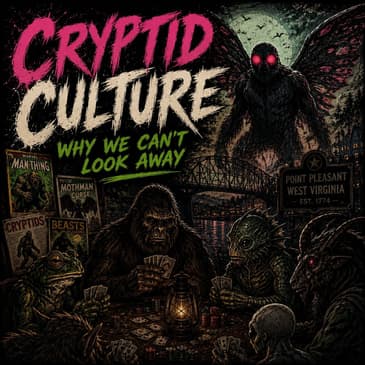
In this episode of Tinfoil Tales, Brandon is joined by author, illustrator, and Cryptid Empire creator David Hardie to discuss the folklore, culture, and enduring appeal of legendary creatures like Bigfoot, Mothman, the Jersey Devil, Frogman, and more.
Rather than debating whether these creatures exist, David explores why these stories continue to resonate across generations. The conversation covers the surprising rise of cryptid culture, how comic books, horror films, and heavy metal helped shape modern monster mythology, and the incredible success of the Mothman phenomenon in Point Pleasant, West Virginia.
Visit David Hardie and Cryptid Empire:
https://cryptidempire.com
Become a supporter of this podcast: https://www.spreaker.com/podcast/tinfoil-tales--6147818/support.
Want to be a Guest?
If you have a paranormal encounter, conspiracy theory, or unexplained story to share, we'd love to hear from you! Reach out to us at tinfoiltalespodcast@gmail.com or use the contact button on our website.
http://www.tinfoiltales.com
Let's schedule you for a future episode and dive into the mysteries together!
Got Weird Stuff?
Have some strange physical evidence you want to share?
Mail it to:
Tinfoil Tales
P.O. Box 302
Peru, IN 46970
Follow Us on Social Media:
Stay engaged on Facebook to join the conversation.
http://www.facebook.com/tinfoiltales and look for Brandon Tinfoil Tales
Explore mysterious visuals on Instagram and share your own experiences.
https://www.instagram.com/tinfoiltalespodcast
Subscribe to our YouTube Channel:
Hosted by Simplecast, an AdsWizz company. See pcm.adswizz.com for information about our collection and use of personal data for advertising.
[00:00:03] And I just turned around and I pulled ass out of there. I was done. I wasn't dealing with that. The hypocrisy of the cult is one of the things that turned me away the quickest. When I turned my headlights on, it turned and looked at us. And one of the things I remember the most were the eyes were glowing red.
[00:00:30] I see an orb of light. It is just circling these steps like it is waiting for me. And he begins to tell them that he saw a UFO. They're basically like, what are you talking about? That's seven foot up on a tree, peeking around it. And that's where I saw the top of the muzzle, nose and the eyes.
[00:00:58] As soon as I made eye contact with this thing, it felt like death. Welcome back to Tinfoil Tales. I'm your host, Brandon. Tonight we're joined by my guest, David. David, thanks for coming on here tonight and talking with me. Brandon, I am so incredibly excited to be here tonight. Would you like to let the audience know a little bit about yourself? Yeah, I am an author illustrator who's written two books,
[00:01:25] Appalachian Cryptids and Creatures, and then Mothman and Illustrated History. Both have done very well. And I make amazing cryptid t-shirts. So that's who I am. I'm a little bit of a crypto mythologist. I'm very into the stories and the lore and why we believe these things. Not so much, you know, I'm not going to be in the lab trying to produce, you know, Bigfoot scat or anything like that.
[00:01:54] That's not necessarily my take. More so I'm interested in drawing the Bigfoot scat. But that's me. So I'm an author illustrator. That's what I do. And I love to have fun with it. So I just posted something tonight. So anyone that pays attention to my Facebook, they will see this. But I have a nine foot tall metal Bigfoot. Nice.
[00:02:22] And it's out back at my property. It's on the edge of the property. My goats are afraid of it. And from the distance that I took it, the photo is blurry, but you can see the outline. So I posted said nine foot tall hangs out at the edge of my property. My goats are very cautious about seeing it. I'm 100% honest about what I put. I didn't say it was a real Bigfoot. I just stated what's out there. So I'm kind of wondering if anyone, by the time this episode airs, if they looked at it and thought that was a real Bigfoot out there.
[00:02:52] But you have a few shirts that I actually have. I've got a frog man one and I have the moth man one. And every time I wear the moth man in an event, everyone always comes up to me and asks where I got that shirt from. Yes. Your green Mountain Dew looking moth man shirt is very popular, at least when I wear it. It's ridiculously popular. In fact, it's so popular. I would believe in my heart of hearts that everybody in the state of West Virginia owns that shirt. I've made so many of them.
[00:03:21] It's ridiculous. I mean, obviously they sell elsewhere. Right. But the moth man museum buys so many of those off of me and sells them. And then I sell so many. And then there's other vendors all over the country who are selling them. But I cannot believe they sell and sell and sell. And so, I mean, it's a sweet shirt. It's a, I'm not going to lie. Like if, if I didn't make it, I'd be like, I have to have that shirt, you know? But yeah. Yeah. It's a pretty cool one.
[00:03:50] I, I, you know, when you make shirts, you hope that like, I mean, I have 26 different designs that I sell on cryptid empire.com. I'll tell you what, the hope is that like three of them will be big hits and that's the truth. And that's, and that's what I've seen out of like 26. I got three that just, and it's, it's that one, the, the neon moth man. And then the one to go hunter, one to go hunter sells like hot cakes. So I got your frog man and the moth man.
[00:04:20] Oh, frog man. I love frog man. That is a, my wife got me that one for Christmas last year. So she, the last two crypticons we've both been to and she's always grabbed me a shirt. She got me the moth man one for Christmas. And then this past year she got me the frog man. So we'll be at crypticon again this year. So we'll see. Did you see, did you see the new artwork for crypticon? I did. And you did the artwork for it. I did the artwork. That was a fun project. That was, it's quirky. It's, it's a bunch of cryptids playing poker.
[00:04:50] Um, it's because they're holding it at a casino. Yeah. Yeah. But I, I had a blast with it. A lot of, a lot of great feedback on that one. Yeah. My friend Easton, he did my podcast artwork. Oh, Easton Hawk. He is the best. He, uh, he did one for him a few years ago, I think. Mm hmm. Yeah. I'm glad that they hire the people that are actually their vendor or as a booth there with them as part of the artwork.
[00:05:21] Well, and they try, they told me they try, they very, they try very intentionally to hire the top end cryptid artists. And I'll tell you seeing, I was very honored to be asked. Like when I finally got asked, I was like, ah, yes. You know, because there, there's a who's who, uh, who have done shirts, you know, um, Jamie Snell, um, Sam Sheerton, you know, it's a, and then obviously Easton and to be with those lumped in with those guys.
[00:05:50] I will take that any day of the week. Mm hmm. Yeah. There's a lot of, a lot of talent in the cryptid world. Yeah. We're just drawing, you know, the cryptids draw us, you know, in my guess. Yeah. Well, we all started drawing bigfoot by little kids. Yeah. You know, come on. It's probably some of your, you know, I don't care who you are. Some you're drawing aliens, cryptids, um, some weird conglomeration.
[00:06:18] That's, those were the first things that you were drawing, you know? Mm hmm. So with me is probably dinosaurs and Godzilla, but ever since. Yeah. That makes sense. That makes sense. And now it's, uh, my son, my youngest, he's just turned five and he loves bigfoot. He loves Godzilla. I was like, Oh, he's my mini me. Yep. Oh, my kids, my kids very much. So are my mini me. In fact, my daughter is seven and I just, it brings me so much joy, uh, to be watching
[00:06:48] with the whole family, but specifically my daughter, X-Men 97. Uh, I grew up on, you know, that was my favorite show ever was the X-Men show. And the fact that we all watch it and they all love it. And that, uh, she's so into it. I mean, like the boys, I have two older boys, um, you know, uh, 15 and, uh, 12. That makes sense to me. You know? Like I've kinda, you know, we've done everything together.
[00:07:14] They love the stuff, but the fact that my daughter's into this, oh, that's even better. What got you into drawing cryptids in the first place? Like, was there something that led you to cryptids? Yeah. So I grew up really poor, very, very poor. And the only thing that we could do in Appalachia, so I'm from Pittsburgh, but when I say Pittsburgh, I'm far out from the city. So like, you know, close to Ohio.
[00:07:44] And, uh, there was like nothing to do other than go to the library. And cause that's, it had to be free to do it. Right? So I go to library all the time and I, one time I checked out this book. It was like, uh, extraordinary creatures or supernatural creatures. Trust me. I have tried to find this thing again and I cannot track it down. It was like a big encyclopedia and it had a bunch of drawings and I would check this
[00:08:12] out like week after week and I would just plow through this thing. And you know, it had Bigfoot and had Nessie and had, you know, and I had, I had a cousin who, uh, did a lot of hunting and his dad was a game warden. And like, he would tell me stories about Bigfoot. And I kind of grew up just purely believing that Bigfoot existed. Like, I mean, I knew that there was obviously like, you couldn't go to see him in a zoo, but like, it was just like, oh, okay. Yeah.
[00:08:41] You know, there's a lot of evidence and I think Bigfoot exists, you know? So I was like, okay, well, you know, if my family thinks he exists, then I think he exists. So I, that book, I, I, I bring it home and then I thought I liked to draw. I was in a drawing and I thought, you know, I'm going to draw some of these things. So, you know, you copy it, you draw it, you do that. So I got into comic books like huge in high school, like crazy in the middle school and high school, like comic book era.
[00:09:11] So that's like the nineties era. So like the, the Jim Lee, the Joe matter era is the Rob Liefeld, Tom McFarlane. And, and my dream was always to, to sell at comic book conventions. I wasn't a, I never had done a full comic book, but I had done t-shirts. So I was a screen printer at a local screen printing shop. So I could actually make my own t-shirts.
[00:09:38] And so I started to make my own t-shirts and take them to comic cons. And I made this joke shirt one year and it just had this huge, awesome Bigfoot on it. And it said, I believe that wasn't, here's what was different about it. Most, most Bigfoot shirts, let's be honest. They are like some clip art silhouette of Bigfoot. And then he's flicking you off. He's drinking beer. He's smoking weed.
[00:10:06] He's like, whatever your thing is. And they just like put it on and it's a bad shirt. It's made up. It's like a vinyl print and you wear it once you laugh about you throw it away. So I did this awesome, huge, highly detailed Bigfoot that said, I believe. And it sold like hotcakes. And I'm like, there's something here. But then this lady, it was like fate brought her to me.
[00:10:32] This lady comes up to me years later and she's like, and I was into like the larger cryptid space, but not like fully immersed yet. And she goes, have you ever heard of Mothman? And I go Mothra, you know, like I knew like the, the, the Godzilla villain. Right. And she's like, no Mothman. I'm like, I think I've heard of him yet. She was like, I think if you did a t-shirt for Mothman, it would sell like crazy. And I go, you know what? Okay.
[00:11:02] So I look, I look at Mothman and I had seen him, you know, in the book and stuff. And I'm like, okay, I can, I can do Mothman. So I draw the most imposing, like universal creature, but comic book S inspired Mothman that I could do. Put him on a t-shirt and it blew up.
[00:11:25] So, you know, I sold a ton, but then out of nowhere, it was like the Saturday or it was the Sunday of the con and I was exhausted. And I was just sitting there like trying to catch my breath. And this guy walks up to the booth and my first thought was, wow, that guy looks like Danny Trejo, but he's way too short. So Danny Trejo, uncle Machete from Spy Kids.
[00:11:54] And then everybody knows him from, you know, Desperado, Machete, the movie, every, you know, he's, he's, he's the angry Mexican guy. And he is fantastic. Fantastic. He's amazing. He, it was him. It was actually him. And he walked over my booth, saw my stuff and he went to buy shirts. And I'm like, you've got to be kidding me. This is the first time a celebrity had ever come over to me and grabbed up the Mothman shirt and a few others.
[00:12:23] And he said, Hey, I'll take these. And I said, Oh my goodness. Thank you. That's awesome. And he goes, you have the best shirts here. And I'm like, Oh, you're the, you know, you're amazing. And we got a picture together. Well, I posted that picture and it went for me viral, you know, mini viral, whatever, and caught the attention of the Mothman museum in, you know, Point Pleasant, West Virginia. And they asked me to do, to sell my shirts. And I, I said, absolutely. And they did.
[00:12:53] And then those things started just, they bought 25, 250, a thousand. And now they're just buying them again and again and again. And then turns out there, they, they said things going so well. Would you like to write a book? And I'm like, Oh my goodness. So they had a, they have a publisher. Um, I mean more than just the Montman museum, um, courier press. Uh, and I got signed to a book deal. And I did, my first book was Appalachian cryptids and creatures.
[00:13:22] And I, uh, did 40 different, uh, cryptids that are found in the Appalachian region. And, you know, illustrated them, did all the research, uh, put everything together, went incredibly well. And then I released just a few months ago, my second book, Mothman and illustrated history. And that was, that takes the, the entire story of Mothman from prehistory to the 66, uh, 67 flap all the way to present day.
[00:13:51] And it's gone very well. So like, I'm in this, I find myself in this cryptid space and I love it. You know, there's so much and it's just, uh, got a robust culture and so much history and all these different ways you can go with it. And right now cryptids are huge. So that's where we're at. It is one of those communities that I didn't expect it to be as popular as it actually is. Because it overlaps so much.
[00:14:18] It like, uh, what I've found is that you don't have to just be a nerd or a, uh, you know, a biologist or a goth or a, I mean, insert thing. It's like every single demographic of person is found within this space. And it's really intriguing. And I think here's what I've learned. So doing the cons, the, the, uh, the comic cons, the, I I've had a lot more success with celebrities as of late.
[00:14:48] Like, I mean, Shia LaBeouf, which was a very interesting experience, but Shia LaBeouf came over, bought a bunch of t-shirts. Um, and then, you know, I mean just, and, and others, it was just, it was, it was nuts. But they, they come over and I don't have to explain to them what my weird startup comic about a cyborg fairy princess from Japan who fights a Kitsuni Fox. I'm making all this up, but that's what you normally see at comic cons, right? Yeah.
[00:15:17] It's like, there's like, and instantly, you know, I know Bigfoot. I know Mothman. I know Chupacabra. I know like everybody has some type of like cursory knowledge of these things. And I think even a primal knowledge of these things. And so it's like, yeah. Okay. And you don't have to explain it. There's not necessarily the backstory, you know, the, the back history. Everybody has their different takes, but it's kind of cool. It pulls people in.
[00:15:45] I think it's weirdly socially acceptable now, you know, maybe probably years ago, you know, I laughed. It was like somebody said, oh, I couldn't tell people I was into Bigfoot because they would make fun of me and laugh at me. And I was like, I don't, I don't see that anymore. I mean, maybe a little bit, but not really, you know, like it's, it's more socially acceptable. Oh, it's, I think it's highly socially acceptable now, you know, like it is what it is.
[00:16:13] I mean, there's sometimes it's like, I mean, I will tell you, I gotta be honest. I was going, I got real sick this weekend and I had to get an ER, got bit by tick. Right. So I'm getting ready to go to the ER, had a fever. And I'm going to pick a shirt. And I have like all these awesome shirts, like you have frog man, right? Like, I'm like, I had frog man in my head. I'm like, yeah, I'm not going to wear frog man to the ER. Like that's already going to be too much to explain.
[00:16:42] I need to dress down to do that. So I guess there are some occasions where your crazy, ridiculous cryptid t-shirt might be like a little too much. But I don't think, I don't think that it's socially unacceptable at this stage, you know? Yeah. I've never had anyone say anything about the shirts I've had. And you've mentioned like celebrities. Strangely enough, last year, Ross McQuarrd, I think is how he pronounced his last name or McQuarrd or something like that.
[00:17:10] But he was on the TV show, The Walking Dead. And he also does. Yeah, he was Jesus, wasn't he? He was not Jesus, but he was the guy with Jesus. I can't think of. Oh, okay. Got it. Okay. I can't think of what his name was. Aaron. Aaron. That's right. That's right. Yeah. And he, he's voicing. Yeah. He does red skull and some other stuff. He does a lot of voice acting. He came up to my booth and got one of my dog man shirts.
[00:17:36] And then I got a photo with him, but it was just weird because we, uh, I wasn't expecting a celebrity to come up to my booth and want something from me. You know what I mean? Right. Right. I was like, wait a minute. I know this guy. He doesn't, he doesn't know me, but I know him. So it's pretty cool. Yeah, absolutely. So it was fun. So I mean, it's just like a, yeah, it's a larger culture thing.
[00:18:06] Uh, I mean, and so I speak at festivals. I'm speaking at the Mothman festival this year. Um, and others I'm speaking at the Squonk festival, speaking at various, uh, paranormal cons, those things. And it's all, it amazes me how, like I speak on cryptid culture and people love it. Like they love it. Like we have a blast. I, I, I tell the event planners, Hey, if you want to have a guy who's going to have fun, like we're going to have fun with the crowd.
[00:18:33] We're going to be interactive and I will keep people awake and it'll be very entertaining. Let's talk about cryptic culture. And we just go all over the place, you know, because you have this thriving Marvel cinematic universe, right? The MCU. And it is regardless of how you feel about it. Maybe you have superhero burnout, you know, or exhaustion by this point in time. But I mean, it's big.
[00:19:00] It's the, it is the genre of entertainment, uh, for the most part in culture right now. Almost all of that stuff is based off of cryptids in some, you can tie it back in some way, shape or form. It was all just dating at the same time in the sixties, you know, when it was becoming popular culture. I mean, the Patterson Gimlin film was a 67, uh, you know, the, the fantastic four, what? 63, you know, spider-reel 62, you know, all those different spaces.
[00:19:30] So you have, it's all happening very similarly. And they're basing it. Like I I've oftentimes said to people, it blows their minds. I go, so you get the vision, right? From, from Avengers. I said, the vision is very clearly based off of the flatwoods monster. And people go, oh my gosh. I said, yeah, think about it. We don't know if it's an alien or a cyborg red. What?
[00:19:59] Uh, primarily red and green. There's, you know, yellow. Um, there's weird, strange, like weird, strange powers. He has the, the Cape flap thing that goes up. Now everybody had that back. This Dr. Strange had it all, but it's like all these weird, strange, uh, elements that are shared. And you're just like, and people go, yeah. I said, it's all of star Wars. I mean, you have literally Chewbacca is a space. Bigfoot. Right. Is it?
[00:20:29] I mean, there's no doubt about that. He's a space. Bigfoot. The, the wampa that Luke cuts its arm off at the beginning of Empire Strikes Back. That's a Yeti. That is verbatim a Yeti. You know, like, I mean, I, I mean, there's no, there's all these things, you know, Yoda, Yoda, frog man, you know, like just go. I mean, all the different stuff is Steven Spielberg did gremlins. The gremlins are the hopscanville goblins, like to a T.
[00:20:58] Like if the hopscanville goblins had representation, their lawyers would be calling up Steven Spielberg and suing him. Right. Like it's, it's, it's there, but people love it. They love it. I think a lot of people that come to these events now, and I've noticed this with an uptick, even within my listener base, they are like our generation of people there. It's not so much the younger people, but that's more.
[00:21:26] And I've seen at the events, like even people older than me, like people in their 60s, 70s. And that's because that's what they grew up with. Like, it was like the UFO craze of the seventies, the big foots of the set, like all of that stuff was going on. And I think that's what draws a lot of people in because it's almost nostalgic for them because that's what they grew up with at that height of popularity of it. Well, I had that in your 100% right.
[00:21:53] I, uh, one of my best friends, when I finally got my first book published, you know, you, you get around, you're giving it to all your friends and it's this big celebration. So I give him my book and this guy, okay. He is a math teacher. He is the most like right brain. Like this guy is he he'll build a car. He won't do a drawing of anything ever. You know what I'm saying? So I give him the book and he, you know, he was, he was appreciative as a friend. But it's not his thing.
[00:22:20] So I guess he took the book on family vacation to show his family. Cause I know, you know, he knows my, they know me from when we were kids and everything shows a book to his dad and his dad freaks out. And it's like the Jersey devil. Oh my goodness. I remember all the stories of the Jersey devil. And he's, his dad is a, like an investor. And he's like, like, I mean, he worked for the FF, uh, FFA or FF whatever it was the, the aeronautics.
[00:22:52] He's like going nuts about the Jersey devil. And he's reminiscing about all these stories. He heard growing up in Jersey and the pine barons. And he's like, he got them right. And I love how he drew it. And I like, and he was so blown away that his dad, his dad is gotta be 80 something, you know? And he was so just enamored with my rendition of the Jersey devil. He couldn't stop talking about it. I said, that is funny. That's hilarious.
[00:23:20] You know, but yeah, they grew up with it. Right. Those, that was probably their, it wasn't comic books, but it was close to, you know, some of the lore, some of the things that they were swapping around, you know? Well, do you know, are you aware of how the Mothman popularity started? Can I tell you this tale? You can absolutely tell. So I'm going to, I'm going to give you a little bit of the behind the scenes. Okay. So like, yes, I wrote the book and it's the act.
[00:23:50] Like if you had to take a test on Mothman, my book would help you pass it. Right. Like I got all the facts, all the stuff, all the things, all the sightings, but here's the behind the scenes, cryptic culture. Why Mothman is so incredibly popular today.
[00:24:06] Mothman, like obviously in 1966, it happens, the flap occurs and like, you know, this goes global in that, you know, the newspapers, when it happens, it gets picked up by every newspaper in the world in essence, all the major ones in Tokyo is talking about it, but then like it happened and then it kind of died down. Right. And I, I mean, a lot of people say they don't really, they don't have a recollection unless you were from the area.
[00:24:33] Like maybe you heard about it, but it wasn't this phenomenon that it's become. Here's what happened. They made the movie, the Mothman prophecies, which was based off of John Keel's book, right? Loosely, very loosely based. Richard Hattam did the screenplay and even he says, man, it's very loose. It's not, you know, but they did the movie in 2002 with Richard Gere and Laura Linney.
[00:24:59] But what was so offensive was that they did the movie in Katanning and Pittsburgh, Pennsylvania. They filmed it there. And the locals in Point Pleasant, West Virginia were so angry that they had like, this was their legend, right? Like this was, this was theirs. And so they were like, well, dang it, we're going to have a festival then.
[00:25:29] And so they're like, we're bringing it back to us. Now they worked in unison with the movie. They actually got props from the movie and brought it in. And that was kind of like the beginnings of the Mothman museum, but they go and it was, it was Jeff Walmsley. And I think a few others, it wasn't just him and they go, they have this festival and the festival, you know, it was a successful one, first one, but like, it was the first one of its kind. Like, like nowadays, there's a lot of cryptid festivals.
[00:25:55] I think Brandon, you and I could probably name 30 different festivals, you know, that wouldn't be hard at all. I mean, there might be 50, you might be able to do a festival every single weekend of the year. Right. But back then there were no, there was nothing. I mean, maybe there was a big foot one here or there, you know, but not many, they do this festival.
[00:26:15] And then this thing grows and grows and they go from, you know, 500 people to 5,000 people to 10,000 to 20, but they were at 32,000 people last year. I was there. It was insane. It was like, like the super bowl of cryptid events. Right. And the whole thing, it's all, it's like this local pride, but I'll tell you, it doesn't happen without the Mothman statue. Have you seen the statue?
[00:26:46] I've never seen it in person, but I know the statue. You need to. It is a, it is an Appalachian glorious, strange object. Let me just tell you that it is. So like you pull up to it and you see it and it's like, you think it's going to be this big, huge towering.
[00:27:06] It's really, I mean, it's actually smaller than I think most people think it's well done, but also it's incredibly kitschy. And there's strange, strange decisions were made and I can tell you how they were made. So Bob Roach was a sculptor who was hired to do all these sculptures in Point Pleasant. And like the government paid them, right?
[00:27:33] They're like, Hey, this is a high historical, you know, the context of this area because of, no, they were doing like the, the revolutionary war. And even prior to, um, and they were doing, you know, many different native American, um, statues and, you know, statues of revolutionary war soldiers and different things. And he did, I mean, they're nice and they're like historical and he's like a classically trained sculptor. Right.
[00:28:01] Then they tell this poor guy, Hey, we need you to do a Mothman sculpture. And he's like, what? You know? And so he did his research and he kind of based the Mothman off of, uh, the Frank Frazetta cover from high times, which is not at all what Mothman looks like, you know, but okay, whatever. That's fine. Does the best he can with it and puts it together. And it's, it's, it's, I mean, it honestly looks like a power ranger villain.
[00:28:31] Like that's, that's what the Mothman statue really looks like that for, to me, like I, I, my first time I'm like, Oh, okay. This looks like something Megazord is going to get together and beat up, you know? Yeah. I didn't think it looked a whole lot like a Mothman, but no, yeah, no, no. Well, it looks, the problem is, or not, maybe not problem. Maybe this is the genius of it. It looks much more like a man. And I'll get to that. Then, then necessarily a Moth.
[00:28:59] So one, you have this sculpture that has to hold a bunch of metallic weight. Right. So he has to, these, these thighs, these legs have to hold that. Now they can't break. You can't whatever. But then too, he makes this thing. And I don't know if it was by accident or what, but it has the most pronounced buttocks of any creature statue I've ever seen in my life. Right.
[00:29:29] And it's in a place where it's three, a 360 access. Like you can get to this thing from anywhere. Every, every immature teenager on up to 42 year old, myself included goes right around in the back and takes a picture with the butt. Right. Like that's what everybody's doing. That's what everyone does. And that's, I'm going to have to do it too. If I ever get a chance to get down there.
[00:29:57] You will the shiny, hiney dude. So again, it is, this thing is one I could get in my car. I could, it would take me four hours. I could get in my car. I could drive down the point pleasant. I can walk out of my car. I could take a picture with the butt. Nobody would say anything and I could drive away. I wouldn't have to wait. I wouldn't have to, whatever at this festival, the line to the statue is, it's absurd.
[00:30:25] Like there was a guy who's like, I waited eight hours in line. I'm like, I don't know if that's dedication or we're just ridiculous. And they wait just to get a picture with the butt. Like, it's like, there were, there were people committed. Like, you know that they're not from around there. Right. Like, you know that they are from Europe. They're from Asia. They're from, you know, I heard other, many other languages while I was there. And I'm like, this is, this is a huge big deal.
[00:30:54] Like people are coming in. Like, think about it. The fact that I, and I, from my understanding when talking with people that the Japanese are into mothman, because one, it's a weird, strange American thing. And they love that. They love the strange American monsters, but two, it reminds me of a yokai. It's like one of their yokai.
[00:31:17] And they, they love the cryptic culture and that they're flying over, you know, to America to come to West Virginia to take a picture with the mothman statue. Amazing. Like who had that on their bingo card, right? Yeah. That's the one thing I always see when people go there is they always have to touch the hiney of the mothman. Yep. Yep. It's, uh,
[00:31:44] Well, unfortunately I've seen people do a lot worse than the hiney. Like, like way worse. I'm like, like the one guy recently, I just posted a picture and there was like a group of people. I'm like, I feel like that picture needs to be flagged. I like, like, I think that mothman needs somebody to stand up for him. Like, did he consent to this? Like, you know, what am I seeing right now? Yeah. Poor, poor mothman. I don't know.
[00:32:10] I wonder if the artist that did it and everything, I, you were, you touch base on it. I can tell you, I know you want to ask your question, but I have insight. So go ahead. Did he anticipate the reaction that was going to have? No, not at all. And not at all. And I will tell you that, uh, he, he would be very, he, he would not be happy with the, uh, he was, he would not be happy with the butt stuff.
[00:32:36] I mean, I don't think, you know, like he, none of this make, would make him happy. So he's dead. Um, and I like talked to his daughter. So for like the book, I had to talk to her about putting, cause I have a drawing of the mothman statues. I wanted to talk to her about that and different things. And no, no, no, no, no. He, he would, he's not, he wasn't happy, but he died. I think before it blew up, you know, to the level that it did.
[00:33:02] I mean, it was popular when he was alive, uh, you know, to, to a degree, but like the, the, the, the shiny, hiney element, very embarrassing. Because as an artist, think about like you dedicate yourself to a craft. Somebody gives you a weird project. Uh, and you, you know, you accentuate maybe a part. And my argument is it's structural. I mean, probably he messed it up, but I think it's a mess up, right?
[00:33:30] Like, I think it's like, eh, a little bit too much. And now everybody in the world is taking a picture with your mess up and they don't care that he, like, I, I might be of the 32,000 people who were there at that festival. The people who knew that guy's name, five, 10, 10 people, maybe, you know what I mean? Like it's not. So I don't think, I think I, yeah, he probably feels slighted, you know, in the afterlife, wherever he's looking on from.
[00:33:58] He's, he's all upset and, you know, maybe that consome, you know, or maybe he found peace, you know, finally, who knows? Right. You know, that would, that would be really cruel. The hot, the mothman's butt just haunts him throughout all of eternity. That, that's, that's a tough existence, right? What year did they put that up? Do you know? No, I can look it up. Um, yeah, I can look it up now.
[00:34:23] It was, uh, cause it's all in the statue, you know, I'd have to. Was it before or after the movie came out? Oh, it was after. Okay. I remember watching the movie when it came out the year that it came out, like this was back when. 2002, yeah. I was a senior in high school. Yeah. I, uh, I watched it. We were in it, uh, I think it was a VHS because at that point I don't think I had the DVD player and. Well, that would have been the time when it could have been both. Yeah.
[00:34:53] I think. September. Oh, it was actually September 13th, 2003. So it would have been right after. Yeah. Yeah. But I didn't know when I saw the movie that it was actually a, I, it said obviously based on whatever, but I didn't know the whole story until after I watched the movie. So then I got on the internet and kind of looked it up because I wasn't familiar with. Well, but the history. So much. Like, think about it.
[00:35:22] The movie, it takes place in the nineties, right? Like a very, very clearly it takes place in the nineties. I'm not sure they ever say that it's in West Virginia. Maybe they did, but I don't think so. Um, regardless, I would not have, that was not a major sticking point. Like I would not have thought, Oh yeah, clearly this is in West Virginia. I would have just thought it was in Pittsburgh somewhere, you know? And that's, well, that's why, because they filmed it in Katanning.
[00:35:52] You know, I've been to the courthouse in Katanning where, you know, that big scene that opening or not opening scene, but that you saw it all the time, the street level and then that whole main street. And yeah, that's Katanning. I mean, it's not a big town, but, um, you know, it's not also, it's also not point pleasant. Yeah. The movie was so different. And then they never show Mothman, right? Like he's just a weird presence and you see some, uh, drawings and the red, red eyes that
[00:36:18] they also, they focused a lot on the injured cold stuff, which. Right. That was more of the lore to it, but like, they kind of, it's like, they took so many different elements to what was going on and just made it into this movie. Yes. And then, uh, so Richard Hattam said that that was the, it was budgetary, right? Like that was why. And then he went with, uh, John Keel's theory.
[00:36:46] So John Keel's later in life theory. So, uh, when he put out the, um, the eighth tower, which I don't know what year that was, but that was after the Mothman prophecies, uh, which was clear like his definitive. That was his most popular book. His other books were like moderately popular, but that was Mothman prophecies was what, you know, spurred him onto everything else.
[00:37:10] But by, by the eighth tower, which Hattam had used, he, um, Keel was saying they were all the same thing. He was saying that they were all ultra terrestrials, Mothman, injured, cold, uh, the men in black, the UFOs, uh, whatever. I mean, big foots, fairies, angels, demons, everything.
[00:37:34] They're all like this weird amorphous race of, uh, ultra terrestrials, which are like trickster spirits, kind of the earth's electromagnetic, uh, entities that are causing weird chaos. And they, they just do this throughout time and nobody, they have no rhyme or reason. And that was what he was saying. His thesis was, there's no, like, no, they just screw with people.
[00:38:03] And, um, and so that's what, so the Indra cold stuff, cause the Indra cold, Indra cold and Mothman never even, even in Keel's book, they never coalesce. You know, you have Indra cold with a Darren burger, you know, and appearing to him and I may be a few others, but you know, Woodrow Darren burger. And then the Mothman stuff is all earlier and kind of separate.
[00:38:27] And I mean, they happen in West Virginia at the same time, but it wasn't the same location. No. And it was actually pretty far from each other, like a few hundred miles, you know, uh, which back then would have been a really big deal. You know? I mean, my, my parents growing up in the late eighties, early nineties, my parents would never drive more than an hour anywhere in Appalachia.
[00:38:51] Like, you know, for us to go to Pittsburgh, you might as well been, and that was 45 minutes away. You'd been asking us to go to Paris. You know, it was like, so these, these were, these were, it was regionally similar, but no, not the same, not the same towns. Yeah. I just, there was bits and pieces of the movie, which again, I didn't realize until I was like 16, 17 when it came out, I think.
[00:39:18] Like, and I didn't understand, like I knew Bigfoot, I knew Loch Ness Monster, but I wasn't familiar with Mothman. I wasn't familiar with like cryptids or anything other than like Bigfoot. And I did look into the Mothman stuff and was just kind of surprised that people had been reported seeing Mothman in other locations. Yeah.
[00:39:43] And they claimed that they saw one in, which would have been a Chernobyl. They claimed that there was reports of something around that. The black bird of Chernobyl, right? Yeah. And I know, uh, Lon Strickler has been involved with like the stuff around Chicago. Like, yeah, well, Chicago has a lot, but there's the Michigan one.
[00:40:10] Um, well, there's, I'm finding that they're in Pennsylvania. They've been, there have been sightings in Pennsylvania. So this is a very, very beginnings of a small project, but the, uh, the library system here asked me to do talks on Pennsylvania Mothman sightings. And I'm like, nah, it's not really enough to do anything on. And once I got into the research, I'm like, there's, there's been a decent bit of sightings,
[00:40:38] you know, and then, or there, see, I'm in a weird place. I'm in like, I can, I'm like my house is five minutes from Ohio. Like I can be in Ohio in five minutes. I can be in West Virginia. Now the pan upper panhandle in like 35 minutes. So it's very, very from my house. So this area is like, you know, in the space and then all there's been Mothman settings in, in Ohio, West Virginia, right? Right here.
[00:41:08] And I'm blown away. Like some of these places you look it up and you're like, that's, you know, 30 minutes from me. That's whatever. So there were other sightings and there's contemporary sightings. Um, people shoot it down and you know, whatever, but no, Oh, the month. The funny part is how they say 13 months of terror. It wasn't just 13 months. It didn't stop at all. They just didn't care after the silver bridge collapse. Like that was like the end for people point pleasant. They're like, we don't, we don't care. Right.
[00:41:36] People didn't want to talk about it for a real long time. In fact, actually, I mean, most of the people are gone, you know, cause it happened in 67. I mean, you figure most of that generation's gone now, but, uh, you know, they, they would be very angry at you if you started talking about Mothman there, you know, at a certain point, they're like, just shut up about it. You know? So it took a while for it to gestate and then like become like Mothman has now become like
[00:42:05] the, uh, state bird of Western West Virginia. It's crazy. I dude, I just got like, I I'm selling. T-shirts at, uh, the WV PopCon, which is a comic book convention, like point blank, like popular culture, comic book convention. They reach out to me and they're like, we would love for you to do a talk on Mothman at our show. Sure. You know what I mean? That would be great. I love doing it.
[00:42:34] Clearly I can talk about it forever and ever and ever. But the fact that a comic con is asking me to do a talk on Mothman is hilarious. I actually just did one at the indie PopCon about my documentary this past summer, which there was like only four people in the audience. So that was sure. Yeah. It is what it is, but the, the place is packed, but not that many people really care. But if I, they gave me the hour to talk about it.
[00:43:02] So I talked to who was cool enough to sit down there and listen to me ramble for a while. You know what? And people think that a lot of, oh, you got to speak at, you know, this thing or that thing. Sometimes it's a hit. Like I spoke at one big foot, uh, festival and there was like a lot of people. Like, I mean, uh, you know, for me, it was, it was a few hundred people. It was pretty cool. And then sometimes it's like a little old lady, her therapy dog and, you know, a random kid
[00:43:31] who walked in the room and you're like, okay, we're going to have fun. We'll do the best we can. You know, like, who knows? You just never know what you're going to get with it. Um, but you have fun. Yeah. That's the most important thing is just the, you know, enjoy yourself doing it. People like, I think, I think we're going to see it get real watered down here because everybody's into it now, you know, and then everybody thinks they can speak on it, which some people, here's the thing.
[00:44:00] Some people are fantastic, uh, researchers. They just are terrible behind the microphone, you know, and their people skills can be somewhat lacking and that, that can be a hard put off. You don't have to call me out. Listen, I was, I was one of the four in the audience telling you, you got to work on that delivery, man. Yeah. You know, and some of the words that you dropped, I think you should be canceled. I'm just kidding. I would cancel myself. I'm just going to cancel myself.
[00:44:30] Here we go. Yeah. I, it's weird because I'm not a very outgoing person, but yet I do a podcast where I talk to people and I used to be in a metal band as a vocalist. Nice. So again, I did not know this one metal band. Well, this is actually interesting. You have cryptid empire and the empire, the, the artwork that you have for like your logo. Yeah. We paid someone back in 2009 to do our logo. And I'm pretty sure he used the same style of font that you use because it almost looks
[00:44:59] identical to what we used. Are you serious? You gotta send it to me. That's awesome. Yeah. I mean, I can tell you the names of the fonts. Yeah. He, he tweaked it a little bit, but the band that I was in that had the same one was called Birth of an Empire, but I'm most, most known for the band to my dismay. And one of our songs was called the beast of Bray road. And then we had one called skin Walker.
[00:45:22] So we, I have a dog man shirt that was from the band and we had a other cryptid type of shirt. So my fascination with cryptids and everything has been influenced from my own stuff from like years ago. Well, dude, we got to talk metal. Let me tell you this. You gotta hear this. Cause it, it, my story is very similar then. So I was into, um, like metal, you know, all throughout whatever junior high on, on up.
[00:45:50] And, uh, I organized this group. So we used to go back in the day, um, to this, it was called, it was in central Pennsylvania. And it was called purple door. Okay. So it was a big festival out there at this like ski round top and a bunch of bands, indie bands, like a lot of indie metal bands were out there. And, uh, the, the, the band that I, most people would know was August Burns red. Are you familiar with the name? They're one of my favorites.
[00:46:20] There you go. So August Burns red, this is, so they were relatively new, but very popular. You know, I think they headlined or at least headline the one stage. So I took a bunch, like I took a bunch of people and I had like, uh, I had like, I was the older one. And so like, there's all these kids and I was tired. I was like probably 20 years old at this 21. I don't know. And I was just like, you know what? I don't want to be in the mosh pit.
[00:46:49] I'm just going to enjoy myself and sit. Cause you could just sit in this one space and get the whole experience, but not be getting punched in the face. And I did that. And I was in an artist. So I sit down, put the bag shirt down and I just start drawing. Well, during August Burns red. Okay. Um, it does back then. It was so funny. I just start sketching and it turns into what looked like a Yeti. And I'm like, Oh, that looks cool.
[00:47:18] And so I do the drawing and it, it like, it's one of mine. I can say to you later. I, it was funny. I put Yeti smash on it and this thing blew up. That was my early when I said blew up, I think I sold like 50 of them. But for me, that was a really big deal, but it was Yeti smash. And I drew the Yeti while listening to August Burns red. And one of my friends said, it looks like he's, he's, uh, in a mosh pit, you know, like he's flailing around.
[00:47:48] And I was like, yeah, this was birth out of a, uh, viewing of August Burns red. Uh, which is really funny. And then when I lived out in Lancaster PA for three years and I lived right now, I lived right by, um, Oh, who's the lead singer? Any, Oh man. I can't think of it. Yeah. But I lived, I lived right by his gym. He owns a gym and his ma his gym manager was my neighbor.
[00:48:16] And he would like, and I'm like, so like, it's this funny, weird, like August Burns red is part of my origin story. You know what I mean? Like they, they've been influencing me since like, and maybe subliminally it is. But yeah, that was a fun metal experience, but I'll also do the Eddie. It's, it's funny. They, that's hilarious, man. They played, I only seen them one time. They played the town. That's kind of adjacent to my town, which is not a big town, but they used to bring in
[00:48:45] bigger bands back then. So I went and seen them probably 12 years ago now. Yeah. And I'm sure they've been around here in like Indianapolis or whatever, but I, I very rarely go to music stuff anymore. I don't do band stuff. And when I go and do see bands play, it kind of depresses me cause I miss doing it. Yeah. Yeah. So I've kind of retired from going to that last year. We went to see a, a Monomarth.
[00:49:14] They were playing with the remainder of Pantera, which we watched a little bit of that. I wasn't, I've never really been a big fan of Pantera. I know that's sacrilegious to a lot of people in the metal scene. You're allowed to have that. No, dude, you're absolutely like, yeah, I hear we could talk for hours about that, but yeah, you're that's, that's, I think that's a valid opinion that they, they can be overrated. Right. Yeah. Anyhow, keep going.
[00:49:39] But it got me like wanting to play again. I was like, man, every time I go to a concert, I miss playing music and it's been the last concert. The last show we played was right before lockdown. Yeah. So it's been over six years ago since I've done anything band related. And that's kind of how I do this podcast because I already had the microphone and everything to be recorded our own stuff. So I already had the setup.
[00:50:07] It was just a matter of utilizing it. And then now I've retired from bands to being a podcaster. Yeah. Yeah. Isn't that funny? So I wonder if like the cryptid space is probably a lot of us retiring from another space because they're like what, when people walk up and I, and you're going to be able to attest to this. When you see my shirts, everybody, the nicest thing you can say to me and the thing that will
[00:50:34] get me the most fired up and I'll be super happy with is if you walk up and be like, dude, these look like t-shirts from the early two thousands hot topic band era. They do. And I'm like, heck yeah. That's why I enjoy them. That is like, right. And I'm like, that is me, which dude, the sad thing is that vintage now. Yeah. That's what hurts. It hurts so bad.
[00:51:00] I've always liked the big bright neon shirts like that era of, it was like the MySpace era of t-shirts. It was the best, it was the best era in my opinion, just my opinion, but it caught your eye. It was, they were fun. It was intriguing. And like the work, like you produce some fantastic, you know, artists now, you know, which that's
[00:51:27] like the fear as everything coalesces with this AI stuff. But I think that's the kind of thing, you know, that's what that's like. how it's just, we're losing that, you know? And it just, it's taken, you got all these artists and it just takes off the Dan Mumford, but then it combines them with Tom McFarlane blood. And he gives you this. And you're like, no, you lost the human touch. You know, you lost. A lot of the band stuff. Nowadays, I feel like it's just kind of basically boring.
[00:51:54] It is. Well, and they have no budgets. So that's the struggle is that like, like, I mean, so my nine to five is I make t-shirts for organizations. I used to, I mean, bands, I'll make them for bands, but they never want to pay, you know, like bands always like bands are the hardest to nail down, which I get, they don't have budgets, you know, or they, you know, yeah, they can barely pay themselves, whatever.
[00:52:17] But it used to be that they would have, you know, they, they, they, they find these guys and they'd be able to pay them very back then, like good money for album. The big one was album covers, right? You know, there were, there were guys that back in the day that like, I know of, they were making $10,000 an album cover.
[00:52:37] And then the joke that this one art podcast, I listened to adventures in design. They said, well, all of a sudden out of nowhere, it was kind of post Napster. They said it went from 10,000 and you dropped the zero. And it was like, Oh, we'll give you a thousand dollars for like, you know, you could be designing, you know, August burns red new album cover. And it was like, Oh, it's a thousand bucks.
[00:53:02] And then, you know, and then it's gone down. I mean, even now, you know, some of these guys, it's like, Oh, mate, if you get $500 for a, for an album design, I would think that that would be very high. I think you're doing good. I feel like, Oh, I got 500 bucks. That's great. You know? And they're top level guys. But yeah, the whole thing is very interesting.
[00:53:23] I hired Mark Randall to do my, I know Mark Randall. I hired him to do my documentaries cover art. So like everyone hates AI and I try not to use it for anything specifically. Like, and I honestly think my one shirt probably is AI because I hired someone from Fiverr. I have a Bigfoot shirt. They put in AI. That's so mean.
[00:53:51] But like, I look at it and it sells a lot, but I'm pretty sure it was actually used. It was created by AI. I have a dog man shirt that the artist, again, I hire people from Fiverr. Right, right. And I don't know, but the dog man one, it's pretty cool. But yeah, I try not to use like AI for anything other than when I do my episode art, because I can't afford to hire someone twice a week to do an episode.
[00:54:20] An episode art would be impossible. Yeah. Right. But every, every time I try doing something, I feel like everyone else is jumping the same thing. So now, and I'm sure as I say this, there will be people doing the same thing, but I've went back to going for more of a brutal, like death metal type of episode art. Yeah. Because everyone started doing the same similar thing. It's like, well, no one's doing like the old school, like 2000s era of metal covers.
[00:54:45] So that's what my episode art is going to be. I was like, whatever the topic's going to be, I was like, and I'm going to put it in like this medley looking font. And I still mess around with it and like Photoshop, but for the actual image, I just have like a, I create the image and then I add my own stuff to it. But people are like, Oh, I can't listen to you because you use AI. I mean, Oh, it's become a witch harm. Yeah. It's become a witch harm. Yeah. It's crazy.
[00:55:10] And like, here's like, whether you like it or not, you don't need to, I don't think you need to be saying it, like yelling it being, I'm just, I, that's, that's not what I'm, I'm not looking to do that. You know, I'm not looking to flame people on that. I think that people are misunderstanding the whole AI thing right now. Like I understand that what we're doing right now, there's databases.
[00:55:38] Like you think of Google, you think of Facebook, you think like all these big corporations, they all have these data centers. Everything that we do, there has to be stored somewhere. And people think that because someone generated an image, you're ruining the environment, which doesn't help the environment. But you're, it's not just that. Yeah. Right. Like your phone is my new iPhone is AI powered. Literally keep saying like everything we do has artificial intelligence nowadays.
[00:56:04] Like even my vehicle, we just got a new vehicle and it can drive for me if I wanted it to. Like it says hands-free driving. Well, how does it become, like, how does it know that? Like if I'm driving, it senses things. So it has its own little bit of artificial intelligence. Right. It's everywhere. We can't escape it. But for some reason, everyone, when they hear the word AI, all of a sudden it's like a trigger word. Oh, without a doubt.
[00:56:31] So I, I don't, and this is, this is me being maybe facetious or something, but I've been to events and I know that the people are selling artwork that is 100% AI generated. Right. And that does kind of irk me because I'm like, you, you're just selling something that's not even real. You did.
[00:56:53] So that to me kind of rubs me the wrong way, but everything else, like I've legitimately tried to do it the best I can to where I at least have someone real, or I think it's, I'm hiring a real person to do stuff. But that's just the old band mentality. Like we used to, I always had to hire an artist, but I always like all my shirts or whatever. I always hired someone off of Fiverr or I knew a local artist and I use them. So it's like, that's just how we always had stuff. Yeah.
[00:57:20] Oh, and I, so I was the friend that everybody knew that was me. That's how I got into it. It was like, Oh, I'm going to have Dave make my t-shirts. Wait, I have to pay him to make my t-shirts. And it will, I'll be, I'll be brutally honest. Like I learned early on that you don't make any money off of artwork. You make money off the t-shirts. Yeah. So I put everything together. And it's just like, I can make, cause I worked through a screen printing shop.
[00:57:47] So I would, after hours, I mean, like I worked the thing up with my boss that I could print whatever, like I brought in. And, uh, you know, I would, I would do the designs, didn't charge for design. I just put costs in the, you know, screen printing. And then they would pay back then. It'd be like, okay, well that was 10 bucks a shirt, you know? And it's like, Oh, cool. Yeah. We'll pay that. You know what I mean? But they wouldn't pay you, you know, a hundred dollars for the design. And then whatever it would be like nine bucks a shirt.
[00:58:16] No, but they would pay 10 bucks a shirt. You know, you just learn that, which is, it is what it is. I've lucked out over the years because I have a friend that worked at a screen printing place. So I used to get the shirts made off the clock. Like I'd go in there helping. We'd print them. Like I'd bring in my own shirts. We'd make the things up. Well, he doesn't work there. He hasn't worked there in like 15 years. So I was like, well, I had to find a different outlet.
[00:58:42] And luckily I know someone from a different band and he started doing screen printing and he was honestly the cheapest. Like for what, if you had one color, he would charge you one. You had to supply the shirts, which I found out you can order shirts for relatively cheap and bulk. And he would charge you $1 per whatever color per shirt.
[00:59:05] So if I did a single shirt and I had a run of a hundred, he would charge $20 for the screen setup. And then, okay. Yeah. And then like $1 per shirt. So I was like maybe 120 bucks for a hundred shirts. I was like, but you know what for him? And here's the deal for him. He's like, that's not even that terrible. Cause for a hundred shirts, it's probably like two hours worth of work. Yeah. So you have $50 an hour. You know what I mean? Yeah. Yeah.
[00:59:33] So he has not been able to do things lately. So I've been back. I got my own screens and I tried to do my own screen printing. So the latest run that I had, we did down in my basement. I had my buddy that used to work at the screen printing place, helped me come over and set it up. And I printed those. And then I was like, man, I just probably end up higher than someone else do. I was like for as long as it took and as much as I spent trying to do it, like it's not worth it. Yeah. I just don't have the setup for it.
[01:00:02] Well, that's, that's where I'm at. I guess. I hear you. I hear you. Like we're kindred spirits in that. Like, you know, back in the day, I was trying to do everything as cheap as I could. And I was doing it myself and I'm screen printing. Like I got out of screen, like me pulling squeegee. Like, no, I'm way too, way too old and busy for that. You know? So it's like, okay, I just got to pay for it. That's how I am now too.
[01:00:28] So I'm trying to find someone locally around here that I can just get with and work something out. There's a couple of places that I've been using. I get hats made from one of them. So I'm considering using them just to make my shirts too. Like it's obviously not going to be as cheap as my buddy was, but it is what it is. Yeah. So, yeah, eventually time catches up with us all, right? Yep.
[01:00:56] Well, and then I'll tell you this, the crazy thing, extrapolating it out. What a lot of printers have told me is, you know, how fast all of the technology is moving that they feel that in the next, not long, like five years, probably less, you're just going to like upload your image from your phone to whatever the service is.
[01:01:23] It's going to print your shirts and deliver them super cheap because there's going to be these big epicenters of printing. Because even Amazon was getting into it or looking into it. No, they did more. They bought, somebody told me it was like $40 million worth of screen printing equipment. Like it's, and then it will just like, it's going to do these things very easily.
[01:01:47] But the DTF market's blowing up too, that direct-to-film printing, direct-to-garment in essence. That stuff's getting, you're going to start seeing that. It's going to bridge the gap. And then eventually in five years, you're going to upload your image. The drone's going to deliver it to you in like three hours and you'll have it same day. Like it's going to be that, it's going to be that crazy. And it will be relatively affordable. The direct-to-garment is actually what I did my dog man went on.
[01:02:16] So we have a heat press and I tried it out. They actually turned out really good. So I don't know how long they will last for. Because I'm old school. I prefer ink. But they look really good. I don't know, like I said, after like so many washes or whatever, what it's going to end up doing. But they're all, they came from a legit company and everything. So the quality, and they actually sized each one for each size shirt that I made. So that was actually kind of nice.
[01:02:45] Because sometimes when you go screen printing, like if you have a small, well, your image is going to be a lot bigger on the small one than it is on a 3X. Because they're using the same screen. These were all made for each individual size. So the size actually adjust per shirt. That's cool. So it was kind of cool. It was a little pricey. But I did all that and I've only sold two so far. I was like, okay, well, I need to sell more because now I'm really in the hole.
[01:03:14] Story of my life. Story of my life.
[01:03:46] And refill my stock. Right. That's cool with me. I was like, I'm not trying to do this for a living. And I was like, I just think it's cool if people want to wear something that's like, I'm a podcast. So to me, it's almost like still wearing my band shirt. Like the shirts still resemble band shirts to me. Like it's got the podcast logo on the front of it. And I'm still in my. It's a great feeling though, right? Yeah. Like that endorphin rush when you see somebody else wearing your shirt. Oh gosh. Yeah.
[01:04:14] So, you know, for me, I, what, what I love is like, I mean, just brings me so, so much joy is scrolling on social media. And somebody, I have no idea. I have no idea. I have no clue who they are. And they're wearing my t-shirt in a picture. And you're just like, yes, that's cool. I love that. I've only seen it like once or twice. And I was actually, this was strangely.
[01:04:41] And I, they had to have bought it from me or one of my people was working with me. And I have sold them a shirt, but I was just at a Bigfoot festival, uh, Red River Gorge. I was there with you. Yeah. And, uh, I saw people walking around wearing one of my shirts. Like I saw a couple of different people. I was like, I have no idea who that is, but that's, um, that's pretty cool. They must've bought it from me from one of these other events. That's a great feeling. Yeah.
[01:05:12] That is a great feeling. That's the other thing that a lot of people don't know about these events is when we do so many, we all start to have that camaraderie with each other. Because I've met some other podcasters from doing this. I've met some other artists and like at CryptidCon, I hang out with a couple of different people and we always go out and have a good time after the event. So that's the thing. Like when you start doing all these events, you make more friendships along the way. Yeah. It's like a family reunion.
[01:05:38] It is like, I, it, like some of the, some of my best friends right now are people are like the con folk, you know? Like I am not, so I got sick this weekend and I'm on antibiotics. I'm not going to be able to make the trip to North Carolina for this big event this week. And I'm mostly bummed out that I don't get to see my friends. Yeah. You know, I'm also very bummed out about the loss of income and blah, blah, blah, but I'm, I'm not going to get to see my friends.
[01:06:06] You know, that's, that's a bummer. I, we've met, I've met my, my wife and I, we've met several different people and every time we see them, we always have good conversations. Now there's people that we go out and have dinner with after events or whatever. We hang out and it's fun. We look forward to it. It gives us something to do. And then like, I like to go and like, we have four kids, so we don't get a whole lot of time to ourselves.
[01:06:33] So it seems like the only time my wife and I get a moment to ourselves is when we're doing one of these events. I got three kids. I understand, but I bring all three and they have to work. That's what I do. I put them in the sweatshop. So yeah, I don't want to have to be chasing mine around. So no, I don't blame you. Yeah. I don't blame you. We've been going on for over an hour. I would like for you to let everyone know where they can find your shirts at your book at and everything else that they can find any of the information at for you.
[01:07:03] Awesome. So CryptidEmpire.com. So CryptidEmpire.com. That's where you can buy my shirts and my books and you'll love them. They'll be awesome. I'll sign them. You buy the books, I'll sign them. Send them out. So you can find me. So the books are on Amazon, but they're not signed and they're not as nice and I don't make nearly as much money. But if you're in like Australia or Siberia or wherever and you're like, oh, where can I buy these two awesome books?
[01:07:32] Just search them on Amazon. So, you know, Appalachian Cryptids and Creatures by David Hardy. So it's important. H-A-R-D-I-E. So I-E. That's me. And then Mothman Illustrated History. You can buy it there. And you follow my Instagram. So I'm most active on Instagram. I got some really cool stuff coming up. I'm starting a YouTube channel.
[01:08:00] And I've got eight videos filmed. I just got to edit them and get them out there. And my hope was to have it early August. But it looks like it's going to be a little later than that for my launch. Just because, well, I had to go get sick. But we'll make it. We'll make it. That's where you can find me. CryptidEmpire.com. Some pretty cool t-shirts and books. What are some events you got coming up this fall that you'll be at? So the big one's Mothman. So I'll be a Mothman.
[01:08:29] But I've got, I'm speaking at the Albatwitch Festival in Lancaster, PA. Or near Lancaster, PA. The West Virginia PopCon. Squonka Palooza. Which is amazing. It's an entire festival about the squonk. Like, trust me. You got to go. It's in Johnstown, PA. I'm speaking of that. A Paranormal Con in Connellsville.
[01:08:57] I think it's Interdimensions Radio. I'm doing that one. And then I'm doing Crypticon in November. I did the shirts for that. I'll be at that. Got two huge booths. And I've got a book signing, like, mini tour that I'll be posting about on Instagram. Doing a lot of Barnes & Nobles and comic shops. And some different places like that. So, yeah. Awesome. All the stuff, all the things.
[01:09:27] So I'll definitely see you at Crypticon. I've already got my booth and everything for that one. Cool. We'll hang out. Yeah. We'll swap more stories. Awesome. Well, for anyone listening, make sure to check out the show notes. I'll put your link in there to your website. I recommend checking it out and buying some shirts because I own a few. So you can be a cool person like me and buy a couple yourself, too. You are awesome. Thanks for the plug, dude. Yeah. Hey, you have a great night. You, too.
[01:10:03] If you would like to be a guest on Tinfoil Tells, remember to send an email to tinfoiltellspodcast at gmail.com or you can also go to tinfoiltells.com and go to the contact section. Just make sure to reach out and get a hold of me and we will get something scheduled for a future episode. You can also find Tinfoil Tells on Facebook and Instagram. Just look for Tinfoil Tells Podcast. You can reach out to me that way, too. Remember to share the show around. Word of mouth is the best way to help the show grow. And just remember, truth comes at cost. Are you willing to pay the price?