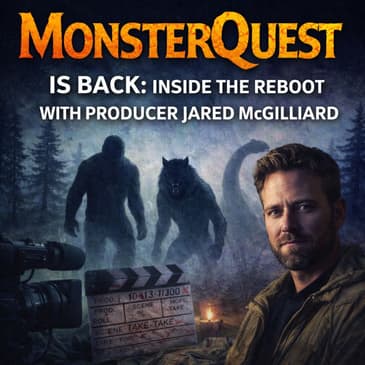
And I just turned around and I call ass out of there. I was done. I wasn't deal with them. The hypocrisy of the cult is one of the things that turned me away the quickest. When I turned my head lights on, it turned and looked at us. And one of the things I remember the most, where the eyes were glowing red. I see an orb of light. It is just circling these steps like it is waiting for me. And he begins to tell them that he saw UFO. They're basically like, what are you talking about. That's seven foot up on a tree, peeking around it, and that's where I saw the top of the muzzle, nose and the eyes. As soon as I made eye contact with this thing. It don't like death. Welcome back to ten Foil Tells tonight. I'm joined by my guest Jared. Jared, thanks for coming on here talking to me. It's dove to be here. Brandon, thanks for having me. Would you like to let the audience know a little bit about yourself? Oh, man, I guess I should. I am. I own a company called The Magic of Films. I've been making TV shows and films for I always think that everything has been like a couple of years, but really it's been like twenty some years. You know, I think everything's just a couple of years ago, but it's been it's been a while. And yeah, the latest project we've been working on is a reboot of Monster Quest, which has just been a blast to put together. So that's just uh, that's just premiered and this week will be episode four. So yeah, that's that's monsters and creatures and unknown, unknown encounters. That's been my world for like, in a very intense way for the past. Year and a half, of all things out there. Everyone always ask why we always go towards monsters and cryptids and everything else, and what is your reasoning for? I have my reasons, but what what was drew you into that? Uh? You know, years ago, I was brought on. When I first started out in the business, I was sort of my I was known to sort of go into sort of dangerous places. You know. I filmed in Afghanistan for a couple of years. I was just sort of the dangerous expedition guy sort of. I was lucky enough to be known for that because it sent me to some really odd places and cool places in the world. And one of the one of the adventures I got to go on is I got to go to the Himalays and Nepal looking for the Yetti for an earlier version of Monster Quest. And yeah, I grew up in the Pacific Northwest, Sasquatch was one hundred percent part of my childhood. I don't I didn't have really any encounters as a kid, but uh, my friend's parents did, people I know that did. So I've always had a general curiosity about this stuff. And you know, we were we were talking to History Channel about a couple of different shows, and cryptids came up, and you know, it was obviously a place that I thought, you know, I always think about what how do I want to spend next you know, the next year or two of my life and I and I've always wanted to sort of do something that that took a kind of a deep dive look into the world's encrypted. So we started as like a really informal conversation and then it just took me down a road. And I've known Adam Davies for a long time and so you know, yeah, that's sort of just sort of like a constant communication about the little adventures he's gone on so I've always been curious about it, and so when the opportunity sort of came up up to sort of do a little bit of deeper dive into it, I jumped at it because it's just it's always something that I've been curious about, and it's it's definitely something that you know, a lot of encounters here in my backyard. And yeah, so that was that was the real reasoning is I I tend to believe that it's more interesting to think that there are things out there that we don't understand and to think that we know it all. And so it felt like a really unique opportunity to sort of to make that my life and my focus for a bit, and I'm glad I did. It's been a lot of fun. I know. The first episode came out a couple of weeks back, and I watched it because I've always been a fan of Monster Quest and I was excited to see the new season come out. But there's several people that I know personally that are involved in it. And the first episode was with Martin Groves and Martin's we were talking to all fair like, he's a great guy, and I was just excited to have the show back on because it's something that twenty years ago was one of the first outlets for me was to watch that show because I was like, oh, there's other people. So it was just one of those things because back then, like when that first came out, it wasn't really it was before Finding Bigfoot. It was before some of these other shows whatever, and you didn't hear a whole lot. You had shows like maybe Psych Deans back in the nineties I think it was, and you had like in Surge of a Leonard Nimoy years and years ago, but there wasn't a show like Monster Quest up until Monster Quest, And I think that kind of paved the way for a lot of the stuff that people do I think be one hundred percent. I don't was it paved the way for me doing my podcast because it gave me that inspiration. So it's it's cool to see it back. So I'm glad that you're involved with it and bringing it back out there for everyone. Oh thanks, man, I appreciate it. Yeah, it's been really fun, And yeah it was a part of of my like you know, growing up and my my that part of my life too, and but yeah, I'm pretty thrilled to be part of bringing it back. It's been a blast, and I like, you know, I think that you know, a lot of these shows tend to live on the sensational side of the story, kind of making it something else or poke holes, and and I always felt like, you know, the original Monster Quest really went about it very objectively and thoughtfully, and and it was kind of fun to carry Torch forward in terms of our approach for this season and just trying to you know, not question it, not try to look for or is not trying to even ask the question is this true? Or is this not true? It really was not the point of the show. The point of the show is just to elevate credible stories where somebody had an encounter with something that they cannot understand, and trying to look into history and trends and patterns to sort of elevate this idea that they are not one off experiences and that these are part of all there are part of like deeper histories and that these people have gone through. So yeah, anyway, I'm glad, I'm glad you're excited that it's back, and I'm pretty excited it's back too. Without ruining it or spoiling it for anyone. What was your favorite story that you guys covered. Is that something you talk about That's. Such a tough question. I mean, you brought up Martin earlier. It's impossible not to at least Martin as my favorite story. You know, Mark is fascinating, and it's so there's so many layers to it, so many sort of mysteries and peculiarities to it. And obviously the area Land between the Lakes is a fascinating place with a really wild history, so that that that story was really fascinating. You know, there's this story coming up in this Friday's episode with which with Shane Luthold, who's a who's's a judge right now in Ohio and he had an encounter when he was a kid in some cornfields out there that that is just a really cool story. You know, it's a really interesting story. And obviously his background and and and and in sort of his place in the in in In as a judge is interesting. He's super credible. So Shane's was really fascinating too. H There's a guy also named John may and Chinsky. He's a he's a wildlife biologist out of Wyoming who had an encounter and his story was fascinating as well. And now I remember leaving that interview with him, and and it was right before Jeff Meldrum passed tragically, and I had reached out to Jeff right after I met John because I thought, oh man, we're going to do a feature documentary with these guys. Like there's just so much of the story and they had some unique evidence, and I think I'm really drawn, you know, two stories where you know, I think some people have a lot to lose by coming out and telling these stories, you know, and somebody who's like a wildlife biologist who exists in science and its credibility is everything to come out and say, oh, I've seen I've had an encounter with sasquatch and this is the evidence I've had. It's a it's a larger barrier for someone to overcome to come out and do that within within through of that scientific community, with a creature that science hasn't recognized yet. And so I don't know, I really John's story is fascinating, has some really cool evidence to it, and you know, there are certain people I've talked to that I feel like are right on that press of of delivering something to the scientific community that I think will just change the narrative to one hundred and eighty by one hundred and eighty degrees, you know, and just general consensus in the public. So out of those three, it's it's hard for me to choose them because I realize there's a really tough question because I found, and I really don't mean this, every story that we crop covered I found to be so credible and so interesting, and I really left those interviews with a completely different perspective on whether it was like an alien abduction or a dog man or a bigfooter goat man. There's a lot of things out there that I feel like we don't quite understand. So there are really incredible stories. There's all sorts of different types of cryptids that you just kind of wonder, like, what are people seeing, because, like you just mentioned goat man, the lore with goat man is usually it's around a bridge, and it's usually like railroad bridge, at least the ones that I've been around here, because I was a goat man festival back in I think it was September October, and it's the stem This is down in Lituisville. It stems for around like this old legend around a bridge. Well there's one in Texas too. It's the same story where it's a goat man, it's around an old railroad bridge. Where does this like where do they come from? Like when it comes to like goat man, this is what I like to find out, Like where did the stories originate from? Like how did the legends happen? Where people are seeing these things all around railroad tracks? Like when we talked off air about dog Man around river systems, Like a lot of people see them around the rivers. So it gives some sort of credence to the idea that, well, if someone sees the goat man around train tracks all the time, around a bridge for trains, and then people see dog Man around river systems, like you have to think that there's some sort of credibility to what the people are seeing because it sounds so similar to what other people talked about that they might not even know someone talked about it before. Yeah, that consistency is undeniable, you know, And there's not. It's not they're all getting together and being like, hey, let's let's right, let's the thing that a connective tissue between our between our stories. Yeah, shadow Man too, like that shadow The shadow Man stuff is something I really I sort of knew about it, but I didn't have any sort of deep knowledge of it. And that was something that really surprised me with this series. Uh that one, That one spooked me out a little bit. But I think sometimes people see something they might not say in the moment, oh, that was a goat man, but then they do exactly what you do, is they they research, they look, they they try to find similarities to what they saw, and they come to theclusion it must have been it must have been that you know, Uh, Gil Sanchez is there's a police officer in the first episode that that believe he hit he ran right over this goat man. He thought e wrecked his entire cruiser. Can't find any any evidence of of anything, you know, any sort of collision or anything. But he sees sees this thing. Then he connected it to these old these old mines in New Mexico is where he felt like that history was. But yeah, there is there are these sort of very strange connections and similarities from one encounter to the next that kind of make it feel undeniable that something peculiar is room and running around that area. This is. We were on our way to a different event and I was at one of those BUCkies. I'm not sure if you're familiar to BUCkies is, but the someone came up to me because I was wearing a shirt that had like a big foot on it, and he just started talking to me because I'm heard of a big foot shirt. Of all things, that brought this guy up and I told him about I was like, well, I just I do a podcast. I'm actually on my way to a bigfoot convention. And then he just did straight looked me in the eye and said, so you're into this type of stuff? I said yeah. He's like, what is something that kind of looks like a deer has like deer looking legs, but it almost had like the body of a pig. It was like, what it's like, I don't And then he proceeded to tell me that when a couple of years ago he was driving a truck at night and he said he swore like a big hog come running out across the road, but it was on deer legs. Wow. I was like, I've never heard of that before, So I don't. I can't tell you anything. I was like, it was just just random random guy saw me wearing a big foot shirt, so he come over. I was like, Hey, you could have been making the whole thing up. Maybe. I was like, but the chances are like, why would you just randomly make that up for no reason? Yeah, No, I don't think so. I don't think so. I think yeah. I think it's one of the more unique things about like just where we are in the specific time with these stories is that there's just a lot of there's a lot of people wearing bigfoot shirts. There's a lot more acceptance about these types of stories, I mean, and encounters in there there ever hasn't been before. And you know, some of the stuff that was really fun of the series was to go, you know, we're you know, part of the cast is obviously just going and talking to people and you know, chatting with someone like you and say I had you should talk to this person. A lot is word of mouth is really how how the whole process happened. But something about it was just trying to find really famous stories, you know, and and then trying to see if there was somebody who could take us right to that and The Mothman. It was a story, you know, like Christina Bennett, the Bennett family, which the Mothman feature film rich gears build up based on their family experience, and man, that was awesome getting sit down with her and talking about I mean, she was only four years old and it happened. But uh, that first person perspective on these very famous stories, which I have some familiarity with, but then hearing somebody specifically, you know, that was uniquely tied to it was really fascinating. Or like Geraldine Stiff with like the the Kelly you know, the Hopkinsville green Men, you know, and she's an amazing storyteller, truly amazing storyteller. But that that that story is is crazy. You know. It's just a really really wild story that not only have stuck with sort of those people, but I've stuck with that family for generations, you know, in terms of like how that sort of continues. So I don't know, it's been It's been a very eye opening experience during that show. There's no doubt it. So I had Geraldine on the show was back in twenty twenty four, but I was actually at Goblin Con with her this past year. She asked me if I wanted to be down there for that. So the first God's great, Yeah, I love Geraldine, she's a great goal. But that when you were talking, that was the first thing I thought. I was like, I wonder if you've actually talked to Geraldine, because I was like, the Hopkinsville story, the Kelly Greenman is one of those stories that I think would have been great to have included in there. So yeah, it's it's in there, in there, Yeah, yeah, it was. It was sort of we heard about the story and then we're like, Okay, let's see who's you know, if there's anyone that can that can tell us about it. And so when we found Geraldine, Yeah, she was an awesome storyteller. I mean I could have listened her talk about that stuff forever. She's a hoot, sweet lady. Yew there her and a couple of other people that I've met from like that. You mentioned the Judge and most of us refer to him as the judge as Shane, but like the Judge, Yeah, the Judge, to be one hundred percent honest. He is the first podcast story that I had ever heard, because I didn't know anything about podcasting. And I come across the show and the first episode that I hit play on was his interview on a different podcast. And I never heard anyone else talk about a dog man before. And this guy is a judge And this is back in like twenty twenty. So this is like when I first started researching how to do a podcast because I didn't know anything about podcasting, and I thought I had a great idea. I'm going to talk about cryptids and aliens and all sorts of stuff that no one's doing, and little that I know that there's a couple. Yeah, so I thought I had a great idea and come to find out that wasn't really all that original. But I still do it anyways. And but no, his I've never actually spoken with him. I've always wanted to, but like, his story is always stuck with me because it's like the first one I actually heard on a podcast. So anytime someone mentions the judge, I was like, yeah, that's kind of while I'm sitting. Here, that was the beginning. That was the beginning for Shane's great Yeah, his story, you know, the way he tells it, it's just so visual. It's just so visual, and you can just imagine it so clearly, you know, and the way we approach these stories, obviously we'd filmed this and done interview, and then we'd sort of storyboard out these these these recreations, and then we'd use a little we obviously do use you know, AI technology to sort of just visualize the creatures. But filming his his recreation was was really fun. I mean, we we I call it, we darked out with that one that just like getting into a cornfield and we hired this actor. He did just an awesome job. But yeah, you kind of like you want the ideas that you're trying to get the audience to sort of just like relive it. But it's it's the way he tells his story is really fascinating and very captivating and very so I can see why that stuck out to you. I was like, and really has stuck. With you through the years for sure, said, I wasn't familiar with podcast. I heard of Joe Rogan and I watched some of his stuff on like YouTube, especially when he interviewed a I can't even think of as Bob Lazaar, the guy that you spouted like Area fifty one. And he said, I've watched his interview, But that's what I thought of podcast. And then I was in my vehicle, I got tired of listening to music. I was like, I'm gonna look up podcast stuff, and that's what I had the idea for starting one. And the first podcast I came across was called Sasquatch Chronicles and the first episode was with Shane. I was like, yeah, I was like, so I got hooked instantly after I heard his interview. I started binging through these episodes and then I was like, yep, I gotta do this now. Yeah. Yeah, it's tough because they know people like Shane, you know Martin, they said a high bar really do for not just like the details and memories that they have of their stories, but also just sort of like how they present. And you know, that was a I actually thought. Finding the stories and finding really captivating storytellers, first person witnesses, it was gonna be tough, and it was not. There's there's yeah I probably say this too much, but it's not like these type of encounters have a type. There's no type. You know. It's it's people that like the judge, it wasn't on his radar, you know, he was just a kid when that happened, running around he's training for the broadwast Fivefinder or something like that, if I remember correctly. I've listened these stories a few times in the in the editing phase, and you know, and these these things just happen to people unsuspected. You know, there's there's no there's no rhyme or reason. Martin story. He was out there, he didn't he didn't believe, and he didn't think about this. It wasn't even something that was crossing his mind. He was He's just thinking turkey and dinner is all he was thinking in a break. So, yeah, they they set a high bar for the type of stories that we were going after. But yeah, they're I think the most the most credible stories you hear are the people that aren't looking for it. It's the random instances of the just so they happen to see something that happened to run into something. Like when people tell me that they've been out hunting these things and all this, and I have all these encounters all the time, I'm like, Okay, I'm not going to say you're full of crap. But at the same time, it's like there are so many people who go out there and do that, never see anything. How come you can have all these encounters all the time, but all these other people don't see anything. And then it's the people that were not even wanting to see something that get freaked out by it, don't even want to talk about it. I was like, that seems to be the ones that stick out the most to me because it resonates with me because I understand it at the same time, like you don't want to talk about it, you don't want to deal whether you're just like no, I don't know what that was, don't want to deal with it. Yeah, yeah, it's it's in this sort of it's interesting. You know the show I did before Mass Request, it was on this really wild treasure hunt. I did this this little limited series for Netflix, and and they talked to One of the themes that kept coming up in that show is the cognitive bias. You know, and you have basically created an idea in your head and then and then the evidence sort of feeds into that idea, right Like it's and I think that's why for me, I's similar to you brand, Like I really people's first encounter was the most is the most fascinating to me because there's no there's there's no they're not looking for anything. They're not there's no, there's no, there's no cognitive bias, there's nothing there that they're sort of setting this. So I have this this idea, I'm going in the woods looking for for such and such, and I see I hear something, and I immediately connected, well is it this or is it not? When you're not when you're go in the woods just a camp or not do anything, you're not thinking about them when you hear a noise, just like, well that's an odd noise. You have no organizational nothing to organize it in your head other than after the fat going and trying to figure out, okay, what what was that attached to? You know, And you know, it reminds me of like last week's episode with with Daniel Hamilton and he was a young kid going out, you know, just this hunting of his family and he heard something in that moment he probably thought it was a bear, but afterwards, you know, he heard Ron mooreheads see our sounds and he's like, oh no, that's what I heard. And I find that fascinating when people sort of hear something after the fact, they go looking for answers and they go, wholl that's that's the same sound I heard. But it's so the people's first encounters, I always feel like are the purest. You know, the first time they see something. Doesn't mean that when they see something afterwards they didn't see things. Doesn't mean that they didn't see it. But that first time where it was like that was odd, that was unexpected, I can't explain it, and then you go searching for those answers. But yeah, cognitive bias, man, that's it's a pretty interesting theory. Yeah. I tend to agree with it because even for my if I ever see something again, I feel like I've lost the credibility of anything that I've ever said because it's so random to see something in the first place, And when people are always seeing these things, that's when I start to pump the brakes a little bit. I'm be like, if you see these things all the time, how come there's no evidence that you're seeing it? And I've talked to people that claim that they know that they can't take photos of them. I was like, how does that work? So it's like it gets into like a little murky area that I don't try and like argue with people or prove or does prove anything. But it's like I feel like at this stage of technology where we're at in society and with the shows and everything else, it's gotten to the point to where it's going to take some really definitive proof to bring a lot of people over into the believing side that are on the fence about it just because the stories are great, but there are some I can settle myself. I've seen stuff still that way too, Like I have to see some sort of proof to understand like what's going on out there. And I think that's that's just how it is for a lot of people. I agree, And I think that AI is only going to make it more It's going to make it more complicated it has at this stage. I mean, it's a it's a really great tool for some stuff, but man, it's going to make the credibility and authenticity of an image or a photo will just it'll be so much harder now, so much more difficult. It's kind of a shame, But I think it's just the reality that the evidence evidence now will have a higher hill to climb than it used to. For sure, I know a lot of people don't like to say this or whatever, but I think it's going to take a body. Like there's a lot of people that are against like taking in the life of something like if there's a big foot or anything like that. And people can get mad at me, but I said, if a dog bit ever runs out in front of me, I'm going to run it over because. Because that's that's gonna take. Yeah, right, that is that's what science needs. Science needs a body, you know. I remember when I was doing that the project in Nepaul, and we had brought along this guy, awesome guy Adam was one of them. He was great. But we also brought this guy, Ian Redman, and he was he was the number two day And to Dane Fosse, you know, the great great ape researcher back in the day. Was he was murdered and when she was murdered, he he sort of stepped in, stepped into her she's and we were up there and yeah, and I remember asking him. We were in the pall and we're just you know, surprising around drinking, drinking a little whiskey or something. One night and I was like, hey, man, you know, what are you think and do you think that like something like this could really exist up here? And he said, well, you know, people didn't believe the great Apes of run Goo were real for forever until two British guys saw one, killed them and brought back the body. I mean, that's that, That is how science moves to recognize these things. So you have to have the body, you have to have evidence. So I totally agree. I think that will be the the piece of evidence that really changes the narrative around some of these creatures. You mentioned Adam. I met Adam a couple of years ago to one of those bigfoot gatherings, and he's a great guy. Our booze first set up right next to each other, so we shot the crap all weekend with each other. He's a he's a he's a funny guy. Man. That guy cracks crack, cracks me up. He's uh yeah, he's almost Sometimes I feel like the most unlikely character to go on these big, big expeditions because he is clumsy, as you can imagine. It's incredible you survive some of the places you get in, but he is He's awesome. I love Adam. He just he's such a hoop Yeah, good guy. Yeah, he messaged me the other day and said he had someone I needed to talk to, and he has how we got in contact. So shout out to Adam Davies for hooking us up. Yeah, thank you, Adam, appreciate it. It's a great connector. So when it comes to Monster Quest and everything, and you deal with like the History Channel, how many episodes are there going to be for this season? Yeah, it'll be eight episodes, eight eight hour episodes, so five stories per episode, so forty stories altogether. Okay, And that was something that they were morning was like a minimum five per episode or is that just kind of what you guys ended up filming. No, that was kind of their sweet spot. Yeah, that was their sweet spot as far as what they the number they wanted per episode. And yeah, they do a lot of these sort of I think it's it's kind of comes down to people's attention span these days. You know, I think people are very used to things moving quickly. You know. I tend to, like I tend to over the years, I like slower, slower stories that have more detail. But I think there's a right format for everything. I think this format worked really well. I think early on I was a little more concerned about our ability to fit five stories in it. Maybe it's because I sat down and talked to each one of these folks for like one to two hours each, you know, so I you know, it's like, oh, man, how do I cut that into a ten ten minutes or so story. It's hard to but I the way I shook out it really worked. I think it worked really really well. Five stories per episode, but each one, I will say this, each one of the most stories certainly has a lot more details, you know, And that's why there's so many different platforms for each one of these stories. You know, they're all meant for different audiences. The podcasting platform is great. It's like, you guys can get in such detail with these stories that you know, we're not necessarily able to, you know, and sometimes I'm on a cable show like that. So it's you know, these stories have multiple platforms and multiple reasons, and these stories are there's a reason they re told multiple times, because they're deserving, for sure. But yeah, five five per episode is something that they were hoping we could we could hit and you know, when we got in there and started the editing process, it worked. Pretty well. That's the one thing was my show that I've struggled with when doing my own filming for my documentary is I don't edit anything out that like people talk about in their encounters. I know some shows like cut clips here and they may it all. I leave everything exactly how the person tells it because I feel like if I start to doctor up what they're doing, I feel like I'm pushing it towards a specific way. And I wanted to be authentic to how the person told their encounter. So I don't try and edit anything like that. But with my documentary, I don't have time to keep someone's attention, so I've had to go in and edit some stuff out that wasn't really as needed to be in there. And that's what I've struggled with, is like how do I go into someone's stuff and edit it down because it goes against like my golden rule of what I do with my podcast to try and make everything fit, because you can't have someone talking for twenty straight minutes and then try and keep it all into a very small section of a video. So that's I don't envy you for I to sit through all these interviews and do that, no doubt. The hardest decisions. Those are the high decisions to make, you know, what goes in and what goes out? And you know, I just think, you know, my job is to make sure that the whoever's watching is pulled along, and they want to listen to what's next, and they want to listen to what's next, you know, and and I feel like people are watching television, watching content, not podcast, but that with a finger on the button. You know, we're just trying not to want them to change the channel. But those decisions are the absolute worst, the worst of the artists. It's like the content that ends on the cutting room floor is sometimes real painful. Really really, So you went on this expedition and search for the Yetti? What about that still stands out? Like what did you guys come across when you're out there that you think could have been evidence? I know this has been years ago. But yeah, I mean we didn't, you know, to be honest, like we didn't find we we went out there, we went, we brought along this another amazing guy named Yagi. Yagi was like this and was an incredible mountain climber. Some of the everest multiple times like and he was out climbing in this area. And the reason we went and targeted the area we we we did is because he had found a print a track that he thought could have could belong to the Yetti. So that sort of was one of the areas made us focus on this specific area in the Hemalayas of Nepal. But you know, we yeah, we this is before the time the drones, you know. So when we had like an aerial platform created with a helium balloon with a flair camera at the bottom of it that we raised up at this crazy altitude that you know, remoted down and Adam had like a little monitor that so we could so we could sort of look at this area at night and see if any there are any heat signatures you know, roaming around this area. We we brought a lot of cool tech and a lot of cool people out there, I mean Ian when we went down. So Adam and I went up with the Yagi to this high high altitude area and then we split and so Ian went down to this river area which he felt like was likely a more of a likely habitat for a creature matching the yetis barnable slowman or Yeti's description, and they found some some funny things. They found some skeletons and stuff and that not. You know, we really didn't find any evidence that furthered it, you know, but I think that's kind of the state of any expedition, you know, sort of you go out there and you you try to follow the evidence that sort of has come before you to see what else you can find. And I think we did that really successfully. But I think what I left there with was like a clear understanding of of you know, the Rihan said to me and Adam too, It's like here we are in you know, a very remote area. You know, if we haven't seen this yety, the likelihood that it's seen us as high. You know, they've lived there and be able to distinguish the disguise themselves for years. They know the area very well. The likelihood we're going to find something like that and see it with a creature that knows this area way more than I than we do in it been over generations is so freaking low. But still it planted a very very large seed of curiosity. I will say in myself to just understand, like you know that there, you know, there are certainly, humans have seen a lot of our planet. You know, we've seen a lot of places, but there are still a lot of places that are very remote and untouched where creatures like this can live. And there's places, you know, like around the river systems that were earlier they can't hide as much and there are a larger concentration of sightings. So anyway, just that that trip really just gave me a new perspective, you know, in terms of the conditions by which a creature like a sasquatch or a YETI could exist for so so long and still we don't. We don't have like that that proof, but that doesn't mean that doesn't exist. And personally that got me pretty excited. You know. I like the fact that there are things out there that that humans haven't discovered, and I think that makes the world way more interesting place to live. It'd be very boring if there wasn't some sort of mysteries out there still to solve. Heck yeah, man, heck yeah, I couldn't agree more. I think about when you just mentioned, like just think about just Canada for example, Like all the northern parts of Canada, they're not as populated like Alaska, like, there's so many just untapped areas just around here around the United States that are vast that we don't even think about. Then you have the jungles of Africa and Brazil and we do it's naive to think that we know everything. Oh my god. I did a series years ago up in the called The Last Alaskans. We were up in the Arctic National Wildlife Refuge of Alaska. That's a refuge. It's literally this of South Carolina, and six families have permits to live there. There are no roads, there's nothing, and this remote wild wilderness exists, like you said, exists in our world, and I just love getting the opportunity to exist in those places is pretty thrilling, where it just feels like there's really no imprint of humanity and no really difficult ways to access it as well. So yeah, that's a that was a pretty special part of the world. But I didn't think about this is after de Paul, and I certainly thought about what else exists up here outside of grizzlies, for sure. When I was in that part of Alaska, I guess, well, I'm thinking about this. I'll go ahead and ask of all, like, how did you get involved with making Doctor, like the series and stuff with TV and everything like the stuff that you've been doing. Like, how did you come about being involved in doing all this? Is this something that you want to do as like a kid and went to school forward or just kind of fell into it? No, not really the real this is a real story. It kind of kind of fell into it. So I was I was going to college. I didn't know what I want to study. I knew I liked I like creative stuff though. I liked creating, and I really wanted to travel. And I lived down in Belize for a little bit and I was teaching down there. I sort of dropped out of college and just went did that stuff for a little bit. And I came back and wanted to finish my degree but didn't know what to do. So I applied to a bunch of art colleges. I was, like, I wrote down school design was one and the other one was Emerson College in Boston, and I, this is the long answer to your question, so just sick you could. And I went there and they said what do you want to What do you want to? Uh declared I had a glarter major. And I said, well that Tomcaster, what what's the quickest way I can graduate? And she said film and TV production or studies my dead And I was like, that sounds cool. And so I studied and it was a really good fit. You know, I think I I only had like another year left of my four year degree, and so I did that, and then I moved out to l A and I first started working. I thought I wanted to do scripted stuff. So I was working at Warner Brothers just reading scripts and I just hated that culture. Man. I hated it. Just like everyone's in a suit every day, everyone's just networking. One was hanging out with their friends. And so I called a friend of mine he was working in TV. I just said, hey, get me, get me in source and a T shirt. And I don't care what I'll do. I just want to go do something fun and and I'm The first show I did was like this this it's like kind of it was a pa you know, on this on this reality cleaning reality show. It was pretty nasty. And then when I went to it, just showing the Cayman Islands. And then my next show, I was in the Arctic of Canada working on ice road truckers. You know. It was like a camera out producer and it just it fit, it fit me. But I dove into it pretty pretty big. I mean, I like lived out of my car for years and I just lived on the road, you know. I was this isn't a technical term, but I was like a TV bum, you know. I just I went where the adventure was. And and I love putting myself in places and situations that I didn't exist, and I and I was curious, you know, I might I think I had success because I just liked talking to people about stuff, you know, and sitting in a truck with someone driving up an ice road for one four hours straight, you know, staying up Like I liked putting myself through kind of like that suffering. And I liked just having I would always say, like sort of non disposable conversations, like deep conversations of people fun, but also just asking tough conversations. I'm sure you know this in your job too. Some of the coolest things that I love is I can ask people questions that they're best friends would mask them, you know, because I'm in their life and then I'm out of their life, and I still care about it, and I still keep in touch with a lot of those folks. But my job sort of demands that I asked hard questions in a very respectful way, and I loved that. I just loved having very real, deep conversations. So yeah, I kind of got into it at the right time, you know, when a lot of this travel unscripted. I never really got into like the reality. I didn't like that type of you know, backbinding, high drama stuff. I like man versus mother Nature. I liked going to difficult places and you know kind of I mean this literally, but it is stal writing shotgun with people who are living really extreme lives. You know, that's working with you know, chimps or elephants and remote parts of Africa, or you know, living a unique lifestyle in Alaska. So I just kind of jumped into it. And to be honest, like I think with anything, I found my community. You know, I've met all my good friends in that in that industry, and and you tend to sort of you sort of find your people and then you kind of jump from adventure to adventure to adventure together. And I was also pretty careful about this stuff that I did, and I really wanted to do shows that I felt like there was a real story there. We weren't going to have to make up a bunch of stuff or fake a bunch of drama. Like I really just felt like the real stories enough, and so I picked my projects pretty carefully and that served me really really well, but really just finding out the right people and I just dove right into it. So that was a real long winded No, you're long winded answer to your question. No, you're good. I've always been curious, Like as a kid, one of the things I wanted to do when I grew up was always I wanted to make movies. So I used to get out our video camera and i'd video things and I'd make this little stop motion stuff with my g I Joe's or some stuff like that. But as I got older, I got into music, and then now I have a full time job. I'm in charge of construction projects, highway projects, but at night I moonlight as a podcaster. But it's just one of those things, like I've always found it fascinating when it comes to like making art MA like again, music making shows, to me, it's like you're creating something, Like you said, it's like a creative outlet. I think that's why I come to the podcast, because I can actually do this when I don't have to necessarily rely on a lot of other people. It's just my own thing where I can come out here and talk to people. Yeah, yeah, that's awesome. As a kid, I lived like a I was always into creating and I liked sort of like the chaos of it. I love the chaos of my job, to be honest, and I call it chaos is because you know, especially when I was freelancer, even now, even the nomadic in the company, I would say, what's gonna jump? What's gonna fall from the guy tomorrow? You know what random opportunity is is going to fall from this guy that's going to send me halfway across the world. It's like there's no predictability, and some people really struggle with that, right, Like I think a lot, especially having kids, I need a little bit more predictability that I have when I was younger. But there's still that sort of there's still that piece of unpredictability that I really really like that I can't, you know, I think for myself, I like living in that chaos. I love living in the unpredictability. I love being like, I'm gonna tell stories this year, but I don't know where it's gonna take me. I don't know what situation's gonna put me in front of. And then you got to get them and you got to educate yourself as quickly as possible, you know. And it's such a cool way to continue my education and learn about things that I literally could not have guessed. It could never have anticipated anything that these adventures or stories that I would get that I get to go tell. And I like that about it a lot, the randomness and the chaos of it. And yeah, it's fun. It's fun to create, you know. For me, I think the hard part is just you know, people, I'm sure the same with you. Like when people tell you tell tell me their story and put their trust in me that I'm gonna you know, I'm putting it on a big placem I just want to do the justice, you know, And that really is like what drives me. It's, uh, if my if my mother was on this podcast and that she said, it's your guilt here, your guilt is what drives you. But I think it is It's like I really do have this sort of like sense of of the kind of putting his responsibility. But I like the fear side of me, Like I just want to take and tell these stories as best as I can, whether that's like a SoundBite or or a visual or whatever that is. It's just try to like do that person story justice. And when when every one of these episodes air, like every time Friday night comes, I'm just sitting there waiting for the emails that comea like, oh man, I hope they like I really truly that is like my my level of anxiety. But yeah, I've always loved creative stuff. I love music growing up too, just like you. I never got it. Was never in a band or anything of that, but I just I always wanted to pursue something that felt creative. I think the challenge is always like how do you make that a business? You know? The business of creativity, I think is really tricky. You know. It's just like you. It's once you add that that aspect into it, it inevitably changes it, you know, it changes having to figure out how you monetize that creativity. I remember I worked as like a I used to do like blown glass back in the day. I've grown up in the Northwest. It's like a big thing out here. It's like, you know, it's biking those things. So I remember I did a class with this guy and I and part of the class was like, you know, you had to make like a I made like a really tall, long vase and he's like, I like that. Now the trick is how do I make a hundred of those? And I was like, ah, that doesn't sound fun, man, I want to put this one aside and make a new one. But that is like the business of creativity, which is sort of like that, that repetition. And I think that that's a I think for anyone who has creative endeavors, that's a really tricky thing to figure out. Is the business behind creating and change. And it's the other thing is to keep maybe for me, but like it's to keep the interest of my own self, but also the people that are involved, whether they want to come on the show, the people that want to listen to this stuff. Like you, I have to find the things interesting to keep my own fascination going. And with you travel around doing like it has to be something you would have to be interested in. You wouldn't go and do something that you've already said that you're not going to go to like do reality TV of the drama and stuff like that. It's something that you would enjoy. You have to enjoy what you're doing. Yeah, totally. I think I I can probably convince myself to be pretty excited or curious about most things. You find some sort of justification for it. But you're right, like and I but I think that that's kind of a mindset of just realizing that, like, there's something interesting I think in everything for me, but you come down you got to find it. Like the surface levels, like that's not interesting to me, but there's always something there. And I think that's the part of the story. And I really like is sometimes what's like on the surface is what most people would tell the I'm gonna tell the surface level story, that's the obvious story. But I think what I find interesting in terms of what I do is like is like in this why like most of my interviews I do were like hours and hours and hours and hours long, because that if you wear people down, you find the part of their story or the part of an adventure that I think is interesting. And so that's what I kind of always like It's almost like the search for that little nugget is what is curious to me. That's what that's what I kind of get get excited about. But you're right if if I can't just I wouldn't be if I'm just doing something for like a paycheck or something. Sometimes I wish I was that guy, because it'd be be a little bit easier to operate that way. But I always felt there has to be something else, uh, something else there that that that that speaks to me, and that to your point, that's when I feel like I actually do a good job, you know, And I have like that self. I'm invested in that way. So I feel like when I do my show for me, it's the people are trusting me to enough to come on here talk about things that you can't usually talk about with people. So I feel like it's my responsibility to not alter what they're saying, not do a whole like I present it as this is their word. Now I've said this on other episodes or anyone. This is not I'm not saying that everything that someone comes on here and tells me is one hundred percent factual, but I think they believe what they're telling me. So that doesn't mean that I don't believe them, but it also means, like we talked about it, it could be a mistaken identity. You may not have seen what you think you saw. You may not have experienced with you, but you saw something. Yeah, so it's I wasn't there. I didn't see it. So who am I to say that you didn't see what you said you saw. Yeah, And it's it's it's kind of like it's it's way more interesting to buy in than it is to to not. You know, It's like if I go to a if I go to an interview being like I don't know if I believe this one, Like I'm not going to do a good job either, you know, Like for me, like I go in with I am I'm hooked and it's not false, Like it's not I'm not faking it at all. Like I really go and just like I think, like you're saying, to these conversations, I'm super curious. I really want to hear what people say, and I'm not having the conversation in my head going do I believe this or not? That question is not in my head. It is not the point of it. It's not what I'm after. It's not why I'm having the conversation. And I think that I think that puts people at ease. I think you can read that on people's faces, you know. And for me, I'm always trying to I always truly am like leaning in, like I get out of that and I feel exhausted after an interview. I'm sure people will talk to me feel exhausted too, because I'm just I am I'm hooked, like I'm just really I'm obsessed with their story. I remember what the to Paul can Adam like seeing a hard time about this. But like I went to the call, I remember I turned to my crew. I was convinced we were going to cap we were going to capture visually, Yetti like that. That's That's how I wanted to go into that experience, convinced that what we had put together was going to come back with some evidence. I remember I looked at my crew and I was like, everyone's in charge of getting the shot. You know, just because you're not Adam or Ian or Yagihara and you're not on camera, your job is to keep an eye out as well. Your job is to look around and see what we see because we're in a really unique area. This is a really unique opportunity, and I think we set this up really well and I was bought in, you know. That was that That's what made it exciting for me and believe that this was really going to like net something. So yeah, I'm I'm, I'm. That's kind of like my philosophy with all this stuff is it's it's all, isn't body. I'm always about it. I choose not to live with this. Maybe later I'll think skeptically about it and sort of ponder it a little bit and think about it. But in the moment, I'm just there to sort of like it and just experience it. And I think that's that's it's more fun for me. From all your travels and everything that you have done, has there been anything you've ever experienced that you can't explain as far as like could be paranormal or you mentioned you have like seen anything that just makes you question anything. I mean, Adam took me. I mean, there's definitely been stuff on some of my travels that's been odd, that's been odd. The one thing that one story I had with Adam though, is we were he was coming up to is after we got back from the poll and he was coming back to the Pacific Northwest and he was going to he was going to head up to this area in the Cascades. This area this guy named Donald Lee Wallace used to sort of a big bigfoot researcher back and then I think he lived up there for like twenty eight years. And Adam was with his daughter, and this guy must have recorded, I mean, just had piles of tapes, just gold cassette tapes. I just pictured him like having those old cassette recorders and he would just record the sounds of the Cascades, you know, just thinking what what is he recording? Is he recording the sounds of Sasquatch? And so we went back up there and he took me up there and moved to the tree and got to that tree, and Laurie, who was was Donald, had passed this point. But Donald's daughter went to this tree and he she's talking, hey, big guy, Hey, big guy. Put apples down, and some chocolate and weird nothing. And I brought a buddy along and I was like, oh, I'm not going to hear the end of this. My buddy's gonna give me, give me a hard time about this for the rest of my days. And we walk around a little bit and we come back and Laurie's like, O, Jared, just why he's come over? Just just you and I come over this tree and go to this tree and it's kind of just right early spring. There's still a little bit of snow on the ground. It's like kind of a camping area there's but there's nobody else there. And we go to this area and she's like, hey, big guy, and I heard a growl coming from beneath this tree and then like a knocking from underneath this tree, and uh Brandon. It went on for hours, like a long, long long time, and I'm like my head, I'm like, it's a bear. It's this, you know. I'm just in my head. I'm like, I'm kind of questioning because it's just so bizarre. And the area had had it was like a thick moss floor. There's like a mossy floor basically. And I walked around that area for a long time looking for some entryway in, but I kind of figured it out and I I had a little recorder with me, and you can if you if you have the right headphones on, you can hear the growl, and I think about it a lot, like I think about that a lot, and I just could not explain it. And since there was the same place there I had come back for years and years and years and years, and she said, Oh, yeah, this is the tree that this this asquatch like lives underneath this tree, and I heard it. I can't explain it. Even my buddy that went out there inevitably, he's a dentist. I'm going to see you tomorrow and I guarantee you tomorrow morning. This is what he brings up with me. I guarantee it. It is like it is it is. It is like the constant source of communication, constant, constant source of conversation between us is going back to this event with Adam and the cascades, and I can't explain it. I find that the other the other things that I've seen, I have a terrible memory, have a terrible memory. So sometimes I will think, I, like have a memory, and I can't. I don't know if other people go through this, but I can't sometimes like did I am I just imagining that this happened? Or did this really happen? That one? Mostly because there's other people there. That was a that was an event I cannot I cannot explain, but it was cool. I'm really glad it happened. It was it was awesome. Those things stick with you, the things that you can't explain, and especially like you said, other people there that witnessed it too, like it reassures you that you did hear something, did hear something? Yeah? Absolutely? And you know I was on podcast with Adam Mindy and someone had similar questions. He said, well, what about the moment up in the Cascades. I was like, of course, of course that moment. Yes, that is a that is a weird, odd odd moment. But yeah, it's it's hearing these stories makes you pay attention, you know, it really really does. I live on like five acres out here and in the Northwest, andever I'm walking around my property night with my dog taking her out or something, or going to check on the chickens, closing the chicken coop. Man, I will tell you these stories, Spasure. For the first the first couple of months after I did all my interviews, it was I could not not think about that. I could not walk out of my house into dark and not ponder his dog ran out here, sask here is something from the sky about to come down, and like, you know, shy, I just in my I had to almost say, like Jared, chill out like this, te never seen anything on the property here. But it's you know, I kind of like accepted the fact that I knew that was going to happen to me. I knew that these stories not just because I had experienced what they have, but they've really stuck to me, yea. And they have like literally changed the way that I operate when I'm in the dark and what I'm looking for and what I'm listening to. And it kind of goes back to cognitive bias, you know, even not consciously. Unconsciously, I am like looking and seeking and listening for the unexpected. And it's just I just changed the way I operate. Yep. Funny story. When we first moved out, you mentioned chickens. We had chickens. We don't anymore because mysteriously something kept getting in there and eating them. And it wasn't a big foot or a dog man. It was a raccoon an apostle. But oh yeah, they're a great neis, aren't they. That's right. When we first moved in. We have goats too, and one of the first nights, I went out there and it's pitch black, and I wanted to go out there and make sure the goats went to their barn. And I don't know anything about good oats, so it's pitch black. I'm already looking around because there's corn standing up and everything else, because again I've had my own experience to where I'm I know what's out there, or at least I think I might know what's out there. And I come around to where the goat barn is and the moon is shining, and there's just a silhouette and it's the whole boffamet shape. It's the goats with the antlers like the horns and everything, and it's standing up against a tree eating the bark. But the way I see it, it's on its back legs and it's standing up like a person. And I instantly was like, the fear hits you because you're just like, oh oh, And then I realized it's just the goat eating the bark, but like that, you're just not expecting to go out there and see it on its behind legs. And then the silhouette of the horns sticking up and everything else. I was like, what kind of a house did we just buy? Because apparently the devil's in the backyard. That's right. Oh, that's fascinating. So I want to ask you, like you're the encounter that you had, did it make you want to stay in that area more so? I grew up here. This is where I live now, is probably just three miles from where I grew up in majority, Like, my parents still live down there, My grandparents live down there, and I got a bunch of aunt and uncles. They all lived in this area. And this thing happened to me about two miles up the road from where we live, and now I live just a couple of miles from there, so I actually drive down that road all the time, and my older kids will ask me what am I going to do if I ever see it again? It was like, I'm on trump the gas. So it's for the longest time. Like I said, I've tried to write it off as it was just something explainable. But and if you have time, I'll tell you off air the whole thing because there's a lot to it. It makes no sense and I don't want to bore the audience with it. But there's just so much too. It makes absolutely no sense that I don't. I struggle to accept my own but I struggle to accept what I saw because there's absolutely no reason why this should exist. So it's just one of those things that I get hauntship because I can't explain. And I'm someone that's like very science based. So I was like, there's no biological explanation of how a canine can walk like a human, Like there's no evolutionary line for that, at least not that I'm aware of. Like I could understand Bigfoot as a primate, but how do you explain that about a canine. So that's where I just struggle with it because there's no right, there's no way this would have it should have existed. So I've heard that, or Brandon, you know, you're not alone. I think that, Well, that's that's what makes it stick with you, right, because it's sort of you know, you call like a paradigm shift or whatever you want to call it. It changes. You know, we all sort of our brains we have this this, especially human beings, we have our brains live in a certain terms of order and construct and that's how we survive in the world. Right, you have a certain line of knowns any animal, Right, it creates your patterns of activity, your expectations, we're safe and not safe, something that happens. The reason I think it sticks with us so much is because it challenges that system by which you've been how you've been operating your entire life, you know. And it's it's probably the source of your kid's question too, Hey, if you see this again, what are you going to do? Because it's a whole new It's something completely new. But that's I think that's what makes life interesting. I I think sometimes some some people obviously have some terrible things. But when I would say, as long as I survive it, get through it, I really love it. You know. I look back and I appreciate those experiences because I think they they change who I am, you know. And obviously I'm not talking about just like encounters are the unexpected, but anything that sort of like changes your perspective or reality in the world. As long as you get through it, long as I get through it, I'm like totally for it. You know. It just makes it well, it makes my existence that much more interesting. Yeah, I agree, because most people that I've talked to that have had encounters like this, they're not out trying to find it again, and here I am out trying to run off in the woods chase after these things. So we've been going on for about an hour, so we can probably get ready to wrap this one up. But I was going to ask, is there anything else you would like to discuss beforehand? Because I know with Monster Quest, Aaron, right now, what is on the horizon for you and your company after Monster Quest? Well, recently hoping to do more episodes, you know, if History Channel is up for it, we'd love to do more. We had just a blast putting the season together. It was really fun and and if anything I've learned doing during this season is that there's a lot more stories out there that I would be really excited to tell and and give this sort of platform too. And other than that, you know, we're we're always developing, and I was just say, like staying curious, you know, looking we're playing around with some limited series. You know, I find that whenever I do a show, it becomes a new part of my life. So you know, I did that Treasure show. There's some cool Treasure stories out there that we're sort of searching looking at some more. So it's anytime I do one show, I feel like it just is like a gateway into some more of that other stuff because I just, you know, you kind of want to tell more stories like it. But you know, so it's following a little bit of the stuff that's that we've done historically and then trying to find some new things to dig into as well. But yeah, like I said, it's the greatest part about my job is that it's it's chaos and I can never really predict where it's going to take me kind of take me next, So I'll be excited to find out. But I'll let you know I appreciate it well, Jared. It has been a pleasure talking to you. I hope nothing but success for you and a monster question your company and your next endeavor. Thanks so much, Brandon, really appreciate it. Take care, yep, you have a good night. You too, see it. If you would like to be a guest on tenfoil Tels, remember to send an email to Tenfoil Tells Podcast to gmail dot com, or you can also go to tenfoiltales dot com and go to the contact section. Just make sure to reach out and get hold of me and we will get something to schedule for a future episode. You can also find tenfoil Tales on Facebook and Instagram. Just look for tenfoil Tales podcast and reach out to me that way too. Remember to share the show around. Word of mouth is the best way to help the show grow, and just remember truth comes at cost. Are you willing to pay the price.